It’s multi channel IR remote control so you can perform not just single but so many functions with this remote control. Micro-controller 89C51 is used in receiver part so its programmable remote control. You can program it to perform specific task or for specific application. Some applications that I have developed are “Remote control for home appliances”, “Remotely operated DC Motor controller”, “Remotely operated Stepper motor controller”.
If you are not satisfied with single channel remote control then this project will probably satisfy you. It is multi channel IR remote control so you can perform not just single but so many functions with this remote control and its receiving unit. This is multi channel system but here I have utilize only 4 channels but you can add more switches (and also more functions) up to 8 or even more than that. First we will see some of the features of this system
Features:-
- Simple, small and handy remote control made up of IC 556 ( or Two IC 555)
- Micro-controller(89C51) based receiving unit
- Multi functional, programmable receiving unit
- Application specific programming of micro-controller for industrial purpose
- It’s multi functional unit so can be attached to any application
- It can be used in industries to control/operate any application/device remotely
- It can be used in homes/offices to operate any appliance remotely like fan, bulb, air cooler, table lamp etc.
Now let us see some of its applications. Because it’s programmable and multifunctional unit you can find hundreds of its different application but here I am telling you about the applications that I have successfully implemented with this system.
Applications:-
In homes/offices:- It can be used
# To ON/OFF any 230V AC device remotely
# As a remote fan/air cooler regulator. Means you can ON/OFF
fan/air cooler and even increase/decrease it’s speed remotely
In industries:- it can be used as a
# Remote control for AC/DC drives. You can control all the
functions of AC/DC drive from a safe remote place.
# Remote operated DC-Motor controller
# Remote operated Stepper-Motor controller
After going through all these features and applications you should be very much excited to build this system. Again there are two parts one is transmitter and other is receiver.
1) IR Remote control (Transmitter)
2) Micro-controller(89C51) based receiver unit
IR Remote Control
IR Remote control:-
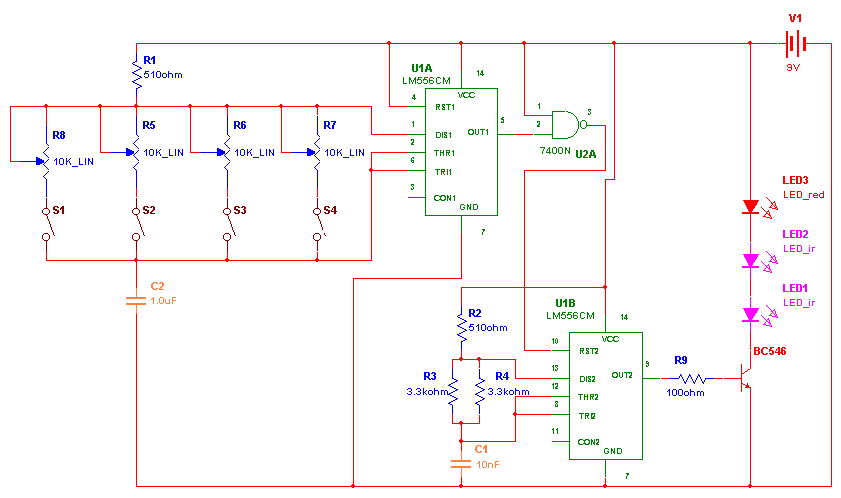
The circuit for multi channel IR remote control is as shown in Circuit Diagram tab.
The main components of the circuit are IC 556(dual IC 555) and IC 74LS00 (4 2inputs Nand gates). Both 555 ICs are connected in astable mode. First one U1A is used to generate low frequency signal around 70-500Hz.Second one U1B generates high frequency of 38KHz.
First 555 IC generates 4 different signals of different frequencies depending upon the switch you press (either S1, S2, S3 or S4). All the frequencies are between 70Hz to 500Hz and it depends upon the pots (R5, R6, R7 and R8). This o/p is given to reset i/p of second 555 IC through nand gate. One i/p to nand gate is tide high so it will work as inverter for second i/p. Initially when all keys are open the o/p of U1A is high so because of inverting operation reset pin of U1B will be held low and thus o/p of U1B is also low.
Waveform
Waveform
Whenever you press any switch it completes the path for astable operation of U1A and it will generate low frequency signal. This signal is inverted and given to reset input of U1B. U1B will generate 38KHz signal only when it’s reset pin is high. So o/p of U1A will frequently switch the o/p of U1B ON or OFF. This is well understood by the waveforms given below.
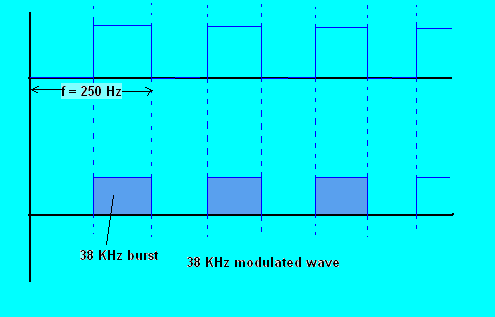
First waveform is the signal given to reset i/p of U1B. Second waveform is o/p of U1B if it’s reset pin is constantly high. Because the first waveform will switch the o/p ON or OFF we will get o/p like third waveform. This is ASK (Amplitude Shift Keying) modulated output. Here signals generated by U1A will be modulating signals and U1B will work as carrier (38KHz) generator.
This modulated output is given to 2 IR LEDs (and also one red LED) through transistor BC546. These IR LEDs will generate IR light beam of 38KHz.
Now the main thing. You have to generate specific frequency every time when any switch is pressed. You can generate range of frequencies from 70 to 500 Hz as you vary 10K pot from min to max. I have chosen some particular values that are 250Hz, 225Hz, 200Hz and 175Hz.
To generate these specific frequencies you need to take help of CRO. Connect the o/p of U1A to CRO. Now short the switch S1. You will get square pulses on CRO. Now start varying pot R8. The frequency will also change. Continuously measure it and stop varying pot when frequency is near about 250Hz (should be in range between 245-255Hz). Do the same procedure for getting other frequencies. The table given below will give you more idea about this.
|
Sr.No |
Switch |
Potentiometer |
Frequency (Hz) |
Range (Hz) |
|
|
Resistor |
Value (K?) |
||||
|
1 |
S1 |
R8 |
2.63 |
250 |
245-255 |
|
2 |
S2 |
R5 |
2.9 |
225 |
220-230 |
|
3 |
S3 |
R6 |
3.3 |
200 |
195-205 |
|
4 |
S4 |
R7 |
3.8 |
175 |
170-180 |
If you want to increases number of channels you need to have more switches and more different frequencies. You can just go on same way and choose frequencies like 150Hz, 125Hz, 100Hz and so on. Please keep in mind these two things
1) Don’t choose any odd number frequency like 136Hz, 166Hz etc.
2) Don’t choose frequencies which are very closer to each other. At least leave
gap of 20Hz between two frequencies.
(Note:- All the switches are of push button type used in telephone. Trimmers are used as variable resistors. they are very small tiny variable resistors can be varied only by a screw driver. 9V standard battery is used as power supply.)
Micro-controller(89C51) based receiver unit
Micro-controller(89C51) based receiver unit:-
The block diagram of unit is as shown below

You need only two main components one is IR sensor TSOP 1738 and another is 89C51 micro-controller. To see features of this microcontroller please refer it’s datasheet. The characteristic of IR sensor is that when it detects IR light of 38KHz it will give low o/p otherwise it will give high o/p. So the modulated o/p generated by IR remote control will be demodulated by this sensor and the pulses will be given to micro-controller.
The o/p of sensor is connected with two i/p pins of micro-controller. One is intrupt1 (pin no.13(P3.3)) and other is timer0 (pin no.14(P3.4)). So when ever pulses detected by sensor and given to microcontroller it will be interrupted and it will start counting external pulses. Micro-controller will count pulses for 1 second. After 1 second it will store the count of timer. Because of 1 second time period this count would be exactly same as remote control frequency. This will be better understood by an example.
Example:- Suppose you press switch S1. So the frequency transmitted will be 250Hz. means 250 pulses in 1 second. Micro-controller will start counting when it gets interrupted and will count for exactly 1 second period so the count in timer will be 250 or around 250.
Now you have to start comparing this count with stored data in micro-controller. Max. and Min. range is given for every count that is +5 and -5. Means range for count 250 is from 245 to 250 (This is why I have suggested range for every frequency in remote control). so if the count falls between this range then micro-controller will lit the first LED (red) on port P0 (corresponding to first switch S1).
Guess what happens when you press switch S2 (or S3, S4). Now the count doesn’t falls between first ranges (because it will be 225). So the program jumps to next range between 220 to 230. Because the count falls between the range program will lit second LED (green). Same process will repeat when you press switch S3 or S4.
Thus depending upon a switch you press from remote control the corresponding LED will glow on receiver unit. Here micro-controller will work as frequency counter as well as band pass filter to detect incoming frequency generated by remote control. And also it will perform a specific task depending upon the specific application for which you are using it.
Stay tuned more interesting part is coming now!!!!!!!!!
Let us see some of interesting applications of this system
Remote control for home appliances
Remotely operated DC Motor controller
Remotely operated Stepper motor controller
Circuit Diagrams
Filed Under: Electronic Projects
Log in to leave a comment:
Lost your password?
Don't have an account? Register here