Engineers Garage

  • Electronic Projects & Tutorials
    • Electronic Projects
      • Arduino Projects
      • AVR
      • Raspberry pi
      • ESP8266
      • BeagleBone
      • 8051 Microcontroller
      • ARM
      • PIC Microcontroller
      • STM32
    • Tutorials
      • Sensor Series
      • 3D Printing
      • AI
      • ARDUINO Compatible Coding
      • Audio Electronics
      • Battery Management
      • Beginners Electronics Series
      • Brainwave
      • Digital electronics (DE)
      • Electric Vehicles
      • EMI/EMC/RFI
      • EVs
      • Hardware Filters
      • IoT tutorials
      • LoRa/LoRaWAN
      • Power Tutorials
      • Protocol
      • Python
      • RPI Python Programming
      • Sensors
      • USB
      • Thermal management
      • Verilog
      • VHDL
    • Circuit Design
    • Project Videos
    • Components
  • Articles
    • Tech Articles
    • Insight
    • Invention Stories
    • How to
    • What Is
  • News
    • Electronic Product News
    • Business News
    • Company/Start-up News
    • DIY Reviews
    • Guest Post
  • Forums
    • EDABoard.com
    • Electro-Tech-Online
    • EG Forum Archive
  • DigiKey Store
    • Cables, Wires
    • Connectors, Interconnect
    • Discrete
    • Electromechanical
    • Embedded Computers
    • Enclosures, Hardware, Office
    • Integrated Circuits (ICs)
    • Isolators
    • LED/Optoelectronics
    • Passive
    • Power, Circuit Protection
    • Programmers
    • RF, Wireless
    • Semiconductors
    • Sensors, Transducers
    • Test Products
    • Tools
  • Learn
    • eBooks/Tech Tips
    • Design Guides
    • Learning Center
    • Tech Toolboxes
    • Webinars & Digital Events
  • Resources
    • Digital Issues
    • EE Training Days
    • LEAP Awards
    • Podcasts
    • Webinars / Digital Events
    • White Papers
    • Engineering Diversity & Inclusion
  • Guest Post Guidelines
  • Advertise
  • Subscribe

Difference between Arduino and 8051(89c51,89c52) Microcontrollers

By EG Projects April 25, 2019

Now a days Arduino is much popular among hobbyist, students, kids and diy circuit/project makers. Almost all prefer to use arduino in their projects. Before arduino electronics, electrical and embedded systems engineers use to work with 8051 microcontrollers, pic microcontrollers, nxp, avr, arm and atmega etc microcontrollers. So whats make’s people now a days to use arduino in their projects. Lets find it out. In this post i will list down the key differences between the microcontrollers and arduino particularly 8051(89c51,89c52) and arduino which makes arduino popular among newbies.

What is Arduino?

Arduino is a development board that houses a microcontroller on it. It has its own dedicated ide(Integrated Development environment). The ide is named as Arduino ide. Arduino ide is free of cost and the board it self cost from $3.5(Chinese version) to $22(Original- Italy). Like other microcontrollers it is also programmed in the same way.

What is Microcontroller?

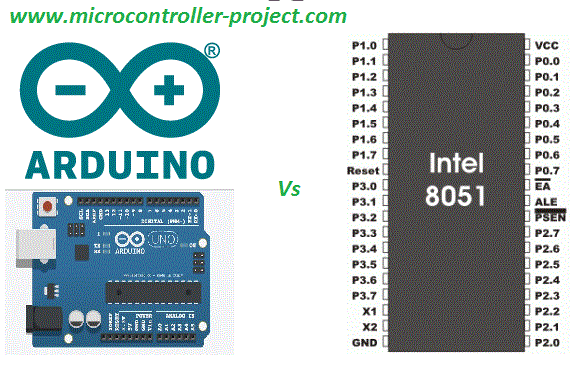
Arduino development board Vs 8051 microcontroller

Arduino development board Vs 8051 microcontroller

A microcontroller is a intelligent unit that acts like a processor. It solves real world problems. Unlike other processors present in the computers/tablets/laptops, it has RAM and ROM built in side it with a CPU. We can also interface external RAM and ROM with it.

8051(89c51,89c52) Microcontroller

Arduino Board

History

  • 8051(MCS51) Developed by Intel in 1980.
  • Followed Harvard Architecture-CISC (Complex Instruction Set Computer). 
  • ​8051 is an 8-bit microcontroller. 16 and 32 bit are also available in market. But we will only focus on 8-bit controllers.
  • Developed at at the Interaction Design Institute Ivrea (IDII) in Ivrea, Italy in 2003 by some graduating students.
  • Followed Modified Harvard Architecture-RISC(Reduced instruction set computing)
  • Arduino houses 8-bit AVR microcontrollers. 32 bit development boards are also released but we will focus on general 8-bits.
  • The initial version is named as Arduino Uno and it houses an AVR Atmega328 microcontroller.
  • Other development board also comes out with time that houses many other AVR series microcntrollers such as ATmega8, ATmega168, ATmega1280, ATmega2560 

Power Requirements

  • 8051 operating voltage is between +5 volts to max 6.6 volts.
  • 8051 operating minimum current is 25 mA.
  • Its GPIO pins can source out 15mA at Max.
  • Arduino boards can work on +5 volts to max 20 volts. On board voltage regulators converters input voltages to +5 volts for microcontroller operation. 
  • Arduino boards can be powered through USB port of computer/laptop as well as with external adopter.
  • Arduino boards are present in logic 5 volts and 3.3 volts. This makes arduino more versatile than 8051. We can interface 5 volt logic devices with 5 volt logic boards and 3.3 volt sensors with 3.3 volts boards. We don’t need to have a level converter. 
  • Arduino minimum operating current is 25mA. Approximately same as 8051.
  • Its GPIO pins can source out 40mA of current. A big advantage on 8051 gpio’s.

Space

  • Flash Memory = 8 kB
  • RAM(Random Access Memory) = 256 Bytes
  • EEPROM= No eeprom

More recent 8051 microcontrollers contains eeprom in them, but many popular 8051 series microcontrollers do not have eeprom in them.
​

  • Arduino uno Flash Memory = 32 kB
  • Arduino uno RAM(Random Access Memory) = 2 kB
  • Arduino uno EEPROM= 1 kB

The upper features are of arduino uno board others boards offer more flash, ram and eeprom.

Clock

  • Clock speed = 12 Mhz 
  • ​One machine cycle = 12 clock cycles
  • ​Single instruction executed in 2 machine cycles
  • More recent microcontrollers have clock speed higher than 100 Mhz but their speed is always less than their equivalent arduino boards.
  • Clock Speed = 16 Mhz could be increase to 20 Mhz
  • ​One machine cycle = 1 clock cycle
  • Single instruction executed in single machine cycle 

Thus arduino has more instruction executing speed.

Programming

  • Generally keil Uvision IDE is used to write and compile code for 8051 microcontroller.
  • One has to know about the registers and pins definitions by compiler to write code for 8051 microcontroller.
  • To upload code in 8051 flash we need an external programmer. ​​
  • Arduino Ide is used to write compile and upload code to the board.
  • A lay man can easily write code for arduino in arduino ide. Its very simple and easy to understand.
  • In arduino flash we can upload code by just connecting the board usb port with out computer/laptop and pressing the upload button in arduino ide. We do not need an external programmer. Arduino board has programmer built on it. 

Feature Set

  • 40 pin package offers 32 GPIO pins.
  • Supports hardware and software interrupts, internal as well as external.
  • No internal pull up resistors.
  • Offer 8/16 bit timers event/counters.
  • No built in ADC(analog to digital converter).
  • One RS232 Uart.
  • No I2C interface.
  • No SPI interface.
  • ​Arduino uno GPIO pins = 14 + 6(ADC) analog to digital pins- can be used as digital. So total GPIO pins = 20
  • Supports hardware and software interrupts, internal as well as external.
  • Internal pull up resistors available (10k)
  • ​Offer 8/16 bit timers event/counters.
  • Offers 6 ADC(analog to digital channels)
  • One-Two RS232 Uart channels.
  • One I2C interface.
  • One SPI interface.

Support – Ad ons

  • Some 8051 development kits are available in market, but the support is poor.
  • Lesser development community.  
  • Very few sensors kits available in market.
  • Many development kits are available in market, with strong support.
  • Huge development community and forums.
  • Many sensors. actuators, motors kits are available in market which reduces circuit making and development time such as rtc(real time clock), temperature, motor drivers, water level sensors, gas sensors etc .

Shields are available in market which can be mounted on the arduino board and can be used instantly. Some arduino stack-able shields.

  • Arduino lcd shield.
  • Arduino WIFI shield.
  • Arduino GSM and GPS shield.
  • Arduino Ethernet shield

Microcontrollers/Development boards

Many microcntrollers fall in 8051 family series. A lot of manufactures made microcontrollers on 8051 core by Intel. Such as Atmel, Cypress, Dallas Semiconductor, Infineon, Maxim, Mentor Graphics and many others. Atmel 8051 series got out of the crowd popularity, few atmel 8051 series family microcontrollers names are below.
80C32E, AT48801, AT8032X2, AT80C31X2, AT80C51RD2, AT83/87C5103, AT83/87C5111,
AT83/87C5112, AT83C5134,AT83C5135, AT83C5136, AT83EB5114, AT85C51SND3, AT87
F51
, AT87F51RC, AT87F52, AT87F55WD, AT89C1051,AT89C1051U, AT89C2051, AT89C
4051
, AT89C51, AT89C5115, AT89C5130, AT89C5130A, AT89C5131, AT89C5131A,AT89C
5132
, AT89C51AC3, AT89C51CC03, AT89C51ED2, AT89C51IC2, AT89C51ID2, AT89C51I
E2
, AT89C51RB2,AT89C51RC, AT89C51RC2, AT89C51RD2, AT89C51RE2, AT89C51SND
1
, AT89C51SND2, AT89C52, AT89C55,AT89C55WD, AT89F51, AT89F52, AT89LP2052, A
T89LP213
, AT89LP214, AT89LP216, AT89LP3240, AT89LP4052,AT89LP414, AT89LP428,
 
AT89LP51, AT89LP51ED2, AT89LP51IC2, AT89LP51ID2, AT89LP51RB2, AT89LP51RC2,
AT89LP51RD2, AT89LP52, AT89LP6440, AT89LP828, AT89LS51, AT89LS52, AT89LS53,
 
AT89LS8252, AT89LV51,AT89LV52, AT89LV55, AT89S2051, AT89S4051, AT89S4D12, A
T89S51
, AT89S52, AT89S53, AT89S8252, AT89S8253,
Various arduino development boards are released by official arduino development team. Each board differs with other in number of GPIO(General Purpose Input/Output) pins, RAM(random access memory), ROM(read only memory), ADC(analog to digital converter), RS232 interfaces offered and many other features. Many other vendors like SparkFun Electronics, Adafruit Industries developed many boards on following the foot steps of arduino. Some board names are below.
Official Arduino:

Arduino Uno, Arduino Leonardo, Arduino Micro, Arduino Mega2560, Arduino / Genuino , Arduino 101/Genuino 101, Arduino Zero, Arduino Due, Arduino Yún
Adafruit Boards:
Adafruit AVR Boards (Flora, Metro, Trinket, Pro Trinket, & Gemma)
Sparkfun Boards:
AVR Boards (ATmega128RFA1 Development Board, Digital Sandbox, Fio v3, MaKey MaKey, Mega Pro (Mini) 3.3V, ProMicro 3.3V & 5V, Serial 7-Segment Display)
Visit the projects created using Arduino development boards and 8051(89c51, 89c52) microcontrollers. All the projects contain free source codes and circuit diagrams.

8051 Microcontroller Projects

Arduino Dev-Board Projects


Filed Under: Knowledge Share, Microcontroller Projects

 

Next Article

← Previous Article
Next Article →

Questions related to this article?
👉Ask and discuss on Electro-Tech-Online.com and EDAboard.com forums.


Tell Us What You Think!! Cancel reply

You must be logged in to post a comment.

Submit a Guest Post

submit a guest post

EE TECH TOOLBOX

“ee
Tech Toolbox: Power Efficiency
Discover proven strategies for power conversion, wide bandgap devices, and motor control — balancing performance, cost, and sustainability across industrial, automotive, and IoT systems.

EE Learning Center

EE Learning Center
“engineers
EXPAND YOUR KNOWLEDGE AND STAY CONNECTED
Get the latest info on technologies, tools and strategies for EE professionals.

HAVE A QUESTION?

Have a technical question about an article or other engineering questions? Check out our engineering forums EDABoard.com and Electro-Tech-Online.com where you can get those questions asked and answered by your peers!


RSS EDABOARD.com Discussions.

  • rechargeable battery and simple alkaline battery in one single product
  • Persistent Shoot-Through vin=vout in Synchronous Buck Converter – Physical Phenomenon Issue
  • Methods for Calculating SNR and SFDR in a CUI for Use in Machine Learning
  • Ensuring Reliable Backups in Azure
  • Switching loss for synch FETs of PSFB?

RSS Electro-Tech-Online.com Discussions

  • WTB: "The Theory Of Servicing AM, FM, And FM Receivers" by Clarence R. Green and Robert M. Bourque
  • Converting 1vac to 24vac
  • AC Input Relay Device Required
  • MLT-8530 Buzzer on ESP32: Why Is the Sound Output Lower Than Expected?
  • Scope Clock CRT Z-Axis - Grid bias positive?

Featured – Real Time Hardware Filter Design

  • Practical implementation of bandpass and band reject filters
  • Practical application of hardware filters with real-life examples
  • A filter design example
  • Types of filter responses
  • What are the two types of hardware filters?
  • What are hardware filters and their types?

Recent Articles

  • EPC’s 100 kHz BLDC inverter supports high-efficiency motion control
  • Melexis announces 5 W smart driver to supports sensorless FOC operation
  • STMicroelectronics’ motion sensor simplifies industrial IoT system design
  • Microchip Technology announces low-power transceiver for critical control applications
  • Coilcraft’s low DCR, low AC-loss inductor optimized for modern processors and power modules

EE ENGINEERING TRAINING DAYS

engineering
Engineers Garage
  • Analog IC TIps
  • Connector Tips
  • Battery Power Tips
  • EDABoard Forums
  • EE World Online
  • Electro-Tech-Online Forums
  • EV Engineering
  • Microcontroller Tips
  • Power Electronic Tips
  • Sensor Tips
  • Test and Measurement Tips
  • 5G Technology World
  • Subscribe to our newsletter
  • About Us
  • Contact Us
  • Advertise

Copyright © 2025 WTWH Media LLC. All Rights Reserved. The material on this site may not be reproduced, distributed, transmitted, cached or otherwise used, except with the prior written permission of WTWH Media
Privacy Policy

Search Engineers Garage

  • Electronic Projects & Tutorials
    • Electronic Projects
      • Arduino Projects
      • AVR
      • Raspberry pi
      • ESP8266
      • BeagleBone
      • 8051 Microcontroller
      • ARM
      • PIC Microcontroller
      • STM32
    • Tutorials
      • Sensor Series
      • 3D Printing
      • AI
      • ARDUINO Compatible Coding
      • Audio Electronics
      • Battery Management
      • Beginners Electronics Series
      • Brainwave
      • Digital electronics (DE)
      • Electric Vehicles
      • EMI/EMC/RFI
      • EVs
      • Hardware Filters
      • IoT tutorials
      • LoRa/LoRaWAN
      • Power Tutorials
      • Protocol
      • Python
      • RPI Python Programming
      • Sensors
      • USB
      • Thermal management
      • Verilog
      • VHDL
    • Circuit Design
    • Project Videos
    • Components
  • Articles
    • Tech Articles
    • Insight
    • Invention Stories
    • How to
    • What Is
  • News
    • Electronic Product News
    • Business News
    • Company/Start-up News
    • DIY Reviews
    • Guest Post
  • Forums
    • EDABoard.com
    • Electro-Tech-Online
    • EG Forum Archive
  • DigiKey Store
    • Cables, Wires
    • Connectors, Interconnect
    • Discrete
    • Electromechanical
    • Embedded Computers
    • Enclosures, Hardware, Office
    • Integrated Circuits (ICs)
    • Isolators
    • LED/Optoelectronics
    • Passive
    • Power, Circuit Protection
    • Programmers
    • RF, Wireless
    • Semiconductors
    • Sensors, Transducers
    • Test Products
    • Tools
  • Learn
    • eBooks/Tech Tips
    • Design Guides
    • Learning Center
    • Tech Toolboxes
    • Webinars & Digital Events
  • Resources
    • Digital Issues
    • EE Training Days
    • LEAP Awards
    • Podcasts
    • Webinars / Digital Events
    • White Papers
    • Engineering Diversity & Inclusion
  • Guest Post Guidelines
  • Advertise
  • Subscribe