
 Global workforces continually undergo changes and advancements. Take the industrial revolution, for example, which revolutionized manufacturing and changed the labor force. More recently, digitalization is altering jobs and the workplace.
It started with computers and wireless networks, and now the internet-of-things is connecting devices and allowing greater automation than ever before. With the additions of artificial intelligence (AI) and robotics, global corporations may soon discover a new workforce that needs no retirement plans, health insurance, training, or time off.
“Approximately 35 percent of American jobs will be replaced by AI in the next two decades,” found a recent study from Oxford University. Careers in manufacturing, medicine, accounting, law, and more may all look different in the next decade.
What’s more, according to a 2019 “AI at Work” study by research firm, Oracle and Future Workplace, 65 percent of people had more trust in robots than their actual managers.
However, AI may also give rise to new developments. Behind every smart software program is an engineer or computer programmer — meaning a workforce will be required to manage robots. Machines may be better and faster at problem-solving and automation but there’s no replacing people for new ideas, communication, and connecting with others.
To keep up with the changing dynamics perhaps a backup plan is needed. Here are six key jobs that were once considered lucrative and now may be vulnerable to AI. Before jumping career paths, however, some changes may occur more slowly than others and remember that all professions will still need that human touch on some level.
 1. Surgeons. Remember the movie “Passengers,” where a patient in a critical state underwent multiple surgeries in a robot-operated pod? That sci-fi concept may become a reality in the near future. It takes surgeons years of study and practice to acquire a steady hand and perform life-saving or risky surgeries well.
Sometimes less than a millimeter of surgical error, such as for brain or spinal cord injuries, can lead to devastating effects and unwanted results.
Surgical robots, on the other hand, need the least time to train, calibrate, and perfect human surgeries. Not to mention, they will typically perform such tasks faster and without succumbing to human constraints such as stress, exhaustion, or emotion.
This means there’s a strong likelihood that several surgeries may, at least in part, be taken over by AI-enabled robots. Humans will have a role to play in this sector but the roles may change significantly.
2. Airline pilots. There is currently little buzz about robots taking over commercial flights but think about it…driverless cars from global automakers such as BMW, Tesla, and others, are already a reality. Could airlines be far behind?
On a smaller scale, Chinese drone maker EHang plans to roll out self-driving hover-taxis that will carry one passenger up to a distance of 100 kilometers within 30 minutes range.
Additionally, the U.S. Defense Advanced Research Projects Agency is already developing a system that will eliminate the need for co-pilots in cockpits, known as Aircrew Labor.
3. Astronauts. AI is quickly making advancements in transportation, including in space. NASA and Google have already deployed robots to the International Space Station. Throughout the last decade or so, NASA has also only used automated exploration rovers on Mars.
Space robots offer a safer option, ensuring zero risks to humans during space travel. These machines can also travel longer distances without fatigue, stress, or risks from the elements. They can also take much greater risks.
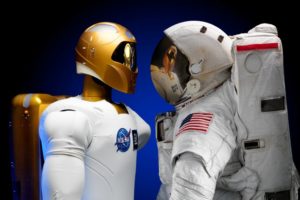
However, AI may also help astronauts in space. In fact, NASA is working with the Translational Research Institute for Space Health or “TRISH” to develop innovative approaches to keep humans healthy in space by using biomedical research combined with artificial intelligence. The AI would help monitor and track astronaut health while in space.
4. Lawyers. Imagine a digital lawyer with an embedded encyclopedia of case laws and statutes and an ability to carry out detailed research little time. AI can easily outpace criminal and civil defenses while analyzing legal data to gain an edge in court.
Although the jobs of lawyers will unlikely face major risks to such technologies in the near future, paralegals and research teams may face greater competition. Statistics show that law firms are already using AI to more efficiently perform due diligence, and conduct research and administrative duties (such as billing hours).
5. Journalists. Did you know that most major publishing houses now often publish stories on business, sports, politics, and others with the aid of a computer-based algorithm? Such algorithms direct programs to analyze online data, take in the most popular searches, and storylines, and turn these into news or new articles.
War stories or natural disasters (say, even a flood, for example) can now be more safety covered with the help of drone journalism. This form of reporting is done with the aid of an unmanned aerial vehicle or drone, rather than risk sending journalists to unsafe regions. The drones can also capture imagery that provides a visual for the news or storyline. In certain instances, locals can also be interviewed with ease via “chatbots” that can communicate in multiple languages and recorded via the drone for a journalist to then report on.
6. Accountants. Software analysis programs have a better ability to identify financial and economic patterns and make trades in a faster and efficient market. Simply put, AI programs can beat humans to the punch when it comes to accurate financial analysis, market predictions, and making smart stock and trade decisions.
With financial trades that involve billions of dollars, it only makes sense to rely on the speed and efficiency of algorithms. Even when it comes to balancing the checkbook, AI can have an advantage.
The above-mentioned sectors are just a few of those that are already being impacted by AI. There are several other noteworthy professions that will see changes, thanks to digitalization and robotics, including construction, data-entry clerks, telemarketers, and drivers.
Nevertheless, machines may become near-perfect but will likely fail when it comes to the imagination, creativity, compassion, and ability to understand others that humans are capable of. Although a job as a surgeon or financial advisor may look different tomorrow than it did yesterday, it’s important people still go into these fields to help direct and support the ideal technical advancements.
Filed Under: AI, Applications, Blog entry, Robotics, Tech Articles

Questions related to this article?
👉Ask and discuss on Electro-Tech-Online.com and EDAboard.com forums.
Tell Us What You Think!!
You must be logged in to post a comment.