
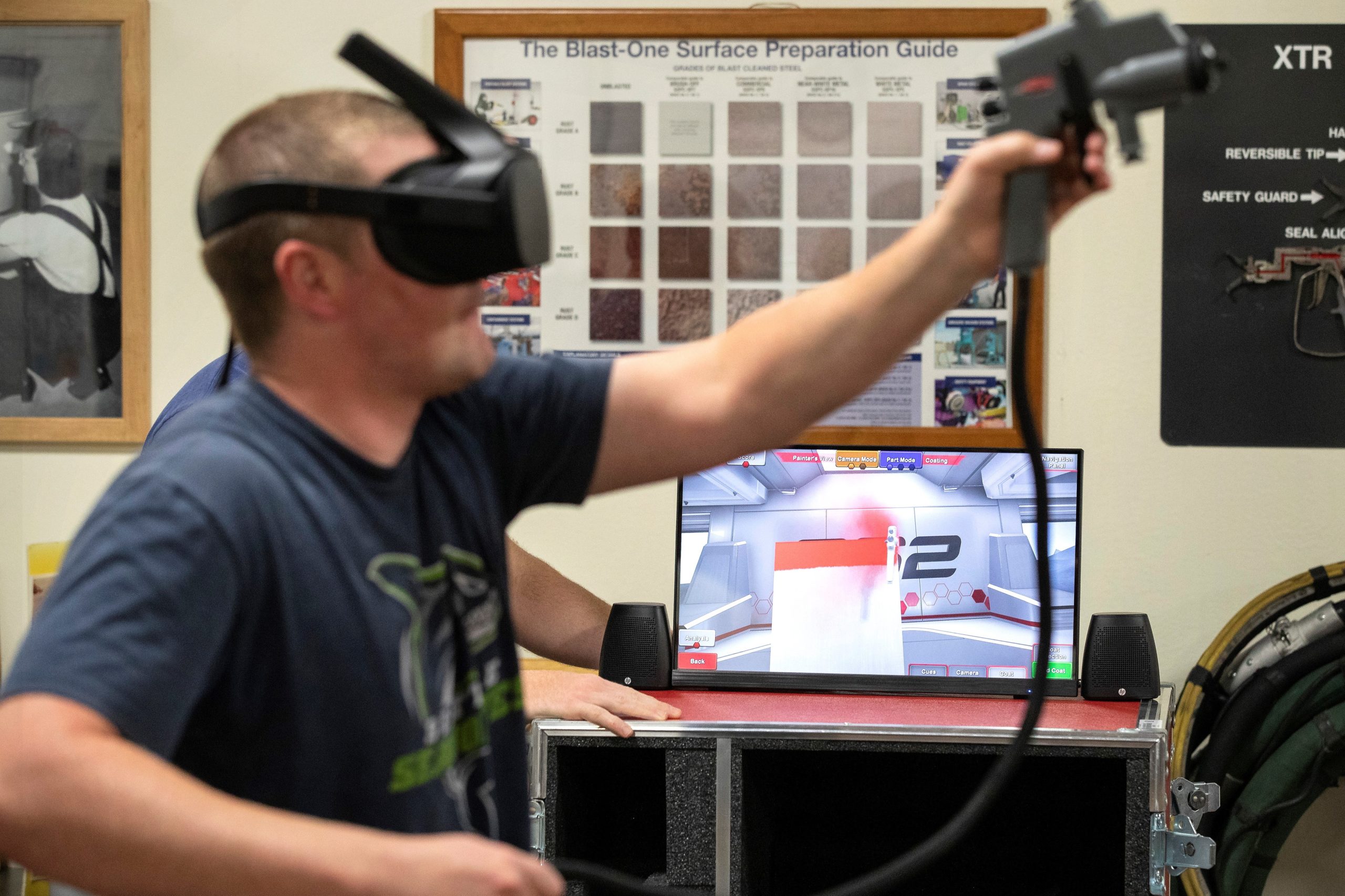
 Recent years have seen increasing use of immersive virtual reality (VR) engineering systems that enable engineers to view their project in 3D quality and spot any flaws or potential risks before implementation. The use of 3D modelling tools and visualization techniques has no doubt become an essential part of the design process as it enables engineers to see virtual prototypes before the availability of any physical prototypes.
Application of AI (artificial intelligence) and machine learning algorithms in VR forms is gradually leading to a profoundly transformative effect, making the technology increasingly sophisticated and subtle.
What is Virtual Reality?
“Virtual”, going by the definition, has the meaning of “being something in essence or effect, though not actually or in fact”. The term “virtual” is also used in the computer sense of “not physically existing but made to appear by software”.
Virtual reality, where users are transported to a virtual environment, is a simulated experience that can be similar to or completely different from the real world. It allows the design team to observe their project within a safe environment, check for faults, structural weaknesses, and other design issues and make changes before the implementation stage, resulting in the saving of both time and money.
VR provides fine-grained details of an engineering product through high-end graphics, video with a fast refresh rate, and realistic sound and movement, enabling the user convenient ways of interacting with and exploring virtual space.
Types of VR
Augmented reality (AR): This technology blends what the user sees in their real surroundings with digital content generated by computer software. This blend of software-generated images with the virtual scene augments the impression of real surroundings.
Mixed reality (MR): This technology merges the real world and virtual worlds to produce new environments and visualizations. This way, physical and digital objects co-exist and interact in real-time.
Simulated reality: This technology is as truly immersive as the actual reality, providing the user an advanced lifelike experience. It involves the use of a brain-computer interface and quantum computing.
Different applications of VR
VR is employed in a number of fields. VR can simulate real workspaces for workplace occupational safety and health purposes, educational purposes, and training purposes. It can be used to provide learners with a virtual environment where they can develop their skills without the real-world consequences of failing. The technology has been used and studied in various spheres such as primary education, military, astronaut training, flight simulators, miner training, architectural design, driver training, and bridge inspection. VR applications are used for modelling of the real environment in various activities such as robot navigation, construction modelling, and airplane simulation.
Entertainment
Entertainment, especially video gaming and 3D cinema, is an important field where VR has been successfully applied. Driving simulators, for example, gives the driver on board the impression of driving an actual vehicle by predicting vehicular motion caused by driver input and feeding back corresponding visual, motion, and audio cues to the driver.
The first fine art virtual world was created in the 1970s. As the technology developed, more artistic programs were produced throughout the 1990s, including feature films.
Social Sciences
In social sciences and psychology, VR helps in the study and replication of interactions in a controlled environment. In such instances, it takes the shape of therapeutic intervention such as virtual reality exposure therapy (VRET), a form of exposure therapy for treating anxiety disorders such as post-traumatic stress disorder (PTSD) and phobias.
Medicine
Since the 1990s, when simulated VR surgical environments were first developed, virtual reality has been used in physical rehabilitation with good quality evidence of its efficacy compared to other rehabilitation methods. Also, VR helps in providing effective and repeatable training at a low cost, allowing trainees to recognize and amend errors as they occur.
Different studies have shown the potential of VR in mirror therapy, robotics for any type of pathology, neurotypical and autism spectrum disorder, and many more medical conditions.
Education
VR is extensively used in education (i.e., medical or military training). Military training acquires realism when it is supplemented with virtual training environments. It also has been found to result in a reduction in military training costs as it minimizes the amounts of ammunition expended during training periods.
Car design
Virtual reality helps car manufacturers produce several versions which are then tested and changed as per the results. This does away with the need for building the physical prototype, speeds up development, and makes it a cost-effective, streamlined process.
Museum
The first uses of VR in museum settings began in the 1990s, seeing a significant increase in the mid-2010s. Additionally, museums have started making some of their content virtual reality accessible.
Digital space
VR’s growing market presents an opportunity and an alternative channel for digital marketing. It is also seen as a new and increasingly evolving platform for e-commerce, particularly in the bid to challenge traditional “brick and mortar” retailers.
Tools, systems, and methods of VR
Thanks to simulation, the user can join the 3D distributed virtual environment in the form of real video as well as a conventional avatar.
By virtue of headsets or multi-projected environments that generate realistic images, sounds, and other sensations, a user can simulate his physical presence in a virtual environment. He can look around the artificial world, move around in it, and interact with virtual features or items. The VR effect comes through the use of headsets consisting of a head-mounted display with a small screen in front of the eyes, or specially designed rooms with multiple large screens. Though generally relying on auditory and video feedback, VR may also involve other types of sensory and force feedback through haptic technology.
3D data is essential to generate realistic models, for which a camera is used for modelling small objects at a short distance. A 3D virtual world is created on a regular desktop display. Video games involve the use of various triggers, responsive characters, and other such interactive devices to make the user feel as though they are in a virtual world.
A head-mounted display (HMD) is found to be very useful in fully immersing the user in a virtual world. This headset usually comprises two small high-resolution OLED or LCD monitors, which provide separate images for each eye for stereoscopic graphics. All this creates a 3D virtual world, a binaural audio system, besides positional and rotational real-time head tracking for six degrees of movement. The user can intuitively interact within the virtual world. He enjoys more freedom of physical movement allowing him to perform locomotive motion in any direction.
Popular VR products
Consumer VR headsets were first released by video game companies in the early-mid 1990s. In the 2010s, next-generation commercial tethered headsets were released by Oculus (Rift), HTC (Vive), and Sony (PlayStation VR).] 3D cinema is used effectively in sporting events, pornography, fine art, music videos, and short films. Since 2015, roller coasters and theme parks have applied VR to match visual effects with haptic feedback.
Companies like Amazon, Apple, Facebook, Google, Microsoft, Sony, and Samsung all have developed VR-related products. Dynamic binaural audio and haptic interfaces; sensor-based tracking; gyroscopes and motion sensors for tracking head, hand, and body positions; small HD screens for stereoscopic displays; and small, lightweight and fast computer processors; omnidirectional cameras, also known as 360-degree cameras or VR cameras are some popular VR devices.
Special input devices for interaction with the virtual world include the 3D mouse, the wired glove, motion controllers, and optical tracking sensors (primarily infrared cameras). This way, the user can move freely without wiring. Thanks to input devices that provide the user with force feedback to the hands or other parts of the body, the human being can orient himself in the three-dimensional world through haptics and sensor technology. Omnidirectional treadmills control (walking in virtual space by real walking movements) and vibration gloves are other instances of the haptic interface.
Virtual reality cameras can be used using 360-degree panorama videos, which can be mixed with virtual elements to merge reality and fiction through special effects. These cameras are available in various formats, with varying numbers of lenses installed in them.
Concerns surrounding virtual reality
The increasing use of VR has also triggered some concerns that need to be addressed by scientists and engineers to realize the advantages of this technology fully.
On the health front, several unwanted symptoms are often caused by prolonged use of virtual reality, such as seizures, developmental issues in children, trip-and-fall and collision warnings, discomfort; repetitive stress injury; and interference with medical devices. One in 4,000 people, or .025% users may experience twitches, seizures or blackouts while using VR headsets, even if they do not have a history of epilepsy and have never had blackouts or seizures before. Since there is a higher prevalence of such among people under the age of 20, children shouldn’t use VR headsets.
At another level, wearing VR headsets may result in flawed physical interactions with one’s environment. The users may become oblivious of their real-world surroundings and may injure themselves by tripping over or colliding with real-world objects.
These headsets may also result in eye fatigue, as is the case with all screened technology. To avoid this, people should try to blink often when watching screens. They should also guard themselves against the possibility of VR headsets contributing to myopia if the focal length of the image being displayed is not sufficiently far away.
Sometimes, exposure to a virtual environment may result in VR sickness — also known as cybersickness or motion sickness. The most common symptoms are general discomfort, headache, stomach awareness, nausea, vomiting, pallor, sweating, fatigue, drowsiness, disorientation, and apathy. Approximately 25–40% of people experience some VR sickness, caused by a disconnect between what is being seen and what the rest of the body perceives.
It happens because the vestibular system, the body’s internal balancing system, does not experience the motion that it expects from visual input when exposed to a virtual environment. The sickness is compounded if the VR system does not have a high enough frame rate, or if there is a lag between the body’s movement and the onscreen visual reaction to it.
Privacy issues
Information gathering of personal actions, movements, and responses through VR also fuels fears of invasion of privacy. It is all the more so as technology involves persistent tracking, which makes the technology vulnerable to mass surveillance.
Conceptual concerns
In 2005. Mychilo S. Cline articulated the conceptual and philosophical fears associated with the use of virtual reality. It is feared, and not without reason, that through virtual reality, techniques may be developed to influence human behaviour, interpersonal communication, and cognition.
Filed Under: Story

Questions related to this article?
👉Ask and discuss on EDAboard.com and Electro-Tech-Online.com forums.
Tell Us What You Think!!
You must be logged in to post a comment.