
Humidity is the presence of water in air. The amount of water vapor in air can affect human comfort as well as many manufacturing processes in industries. The presence of water vapor also influences various physical, chemical, and biological processes. 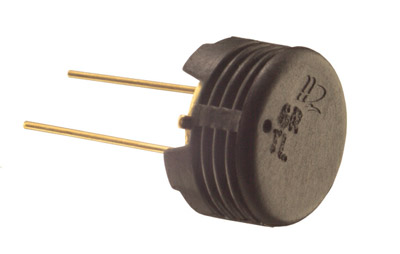
Fig. 1: A Representational Image of Humidity Sensor
Humidity measurement in industries is critical because it may affect the business cost of the product and the health and safety of the personnel. Hence, humidity sensing is very important, especially in the control systems for industrial processes and human comfort.
Controlling or monitoring humidity is of paramount importance in many industrial & domestic applications. In semiconductor industry, humidity or moisture levels needs to be properly controlled & monitored during wafer processing. In medical applications, humidity control is required for respiratory equipments, sterilizers, incubators, pharmaceutical processing, and biological products. Humidity control is also necessary in chemical gas purification, dryers, ovens, film desiccation, paper and textile production, and food processing. In agriculture, measurement of humidity is important for plantation protection (dew prevention), soil moisture monitoring, etc. For domestic applications, humidity control is required for living environment in buildings, cooking control for microwave ovens, etc. In all such applications and many others, humidity sensors are employed to provide an indication of the moisture levels in the environment.
RELEVANT MOISTURE TERMS
To mention moisture levels, variety of terminologies are used. The study of water vapour concentration in air as a function of temperature and pressure falls under the area of psychometrics. Psychometrics deals with the thermodynamic properties of moist gases while the term “humidity’ simply refers to the presence of water vapour in air or other carrier gas.
Humidity measurement determines the amount of water vapor present in a gas that can be a mixture, such as air, or a pure gas, such as nitrogen or argon. Various terms used to indicate moisture levels are tabulated in the table below:
|
S.No
|
Term
|
Definition
|
Unit
|
|
1
|
Absolute Humidity
(Vapor Concentration)
|
Ratio of mass(vapour) to volume.
|
grams/m3
|
|
2
|
Mixing Ratio OR Mass Ratio
|
Ratio of mass(vapour) to mass(dry gas)
|
grams/m3
|
|
3
|
Relative Humidity
|
Ratio of mass(vapour) to mass(saturated vapour) OR ratio of actual vapor pressure to saturation vapor pressure.
|
%
|
|
4
|
Specific Humidity
|
Ratio of mass(vapour) to total mass.
|
%
|
|
5
|
Dew Point
|
Temperature(above 0°C) at which the water vapor in a gas condenses to liquid water)
|
°C
|
|
6
|
Frost Point
|
Temperature(below 0°C) at which the water vapor in a gas condenses to ice
|
|
|
7
|
Volume Ratio
|
Ratio of partial pressure(vapour) to partial pressure (dry gas)
|
% by volume
|
|
8
|
PPM by Volume
|
Ratio of volume(vapour) X 106 to volume(dry gas)
|
PPMV
|
|
9
|
PPM by Weight
|
PPMV X
|
PPMW
|
Most commonly used units for humidity measurement are Relative Humidity (RH), Dew/Frost point (D/F PT) and Parts Per Million (PPM). RH is a function of temperature, and thus it is a relative measurement. Dew/Frost point is a function of the pressure of the gas but is independent of temperature and is therefore defined as absolute humidity measurement. PPM is also an absolute measurement.
Dew points and frost points are often used when the dryness of the gas is important. Dew point is also used as an indicator of water vapor in high temperature processes, such as industrial drying.
Mixing ratios, volume percent, and specific humidity are usually used when water vapor is either an impurity or a defined component of a process gas mixture used in manufacturing.
Correlation among RH, Dew/Frost point and PPMv is shown below:
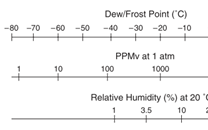
Fig. 2: A Figure Explaining Correlation among RH, Dew/Fros Point, and PPM
HUMIDITY SENSING – CLASSIFICATION & PRINCIPLES
According to the measurement units, humidity sensors are divided into two types: Relative humidity(RH)sensors and absolute humidity(moisture) sensors. Most humidity sensors are relative humidity sensors and use different sensing principles.
A table showing important parameters of different types of humidity sensors is given below:
|
Active Material
|
Thermo-set
Polymer
|
Thermoplastic
Polymer
|
Thermoplastic
Polymer
|
Bulk Thermoplastic
|
Bulk
AlO3
|
Lithium
Chloride Film
|
|
Substrate
|
Ceramic or
Silicon
|
Ceramic or
silicon
|
Polyester or
mylar film
|
N/A
|
N/A
|
Ceramic
|
|
Sensed Parameter
|
Capacitance
|
Capacitance
|
Capacitance
|
Resistance
|
Resistance
|
Conductivity
|
|
Measured Parameter
|
%RH
|
%RH
|
%RH
|
%RH
|
%RH
|
%RH
|
|
RH Change
|
0% to 100%
|
0% to 100%
|
0% to 100%
|
20% to 100%
|
2% to 90%
|
15% to <100%
|
|
RH Accuracy
|
±1% to ±5%
|
±3% to ±5%
|
±3% to ±5%
|
±3% to ±10%
|
±1% to ±5%
|
±5%
|
|
Interchangability
|
±2% to
±10% RH
|
±3% to
±20% RH
|
±3% to
±20% RH
|
±5% to
±25% RH
|
poor
|
±3% to
±10% RH
|
|
Hysterisis
|
<1% to 3% RH
|
2% to 5% RH
|
2% to 5% RH
|
3% to 6% RH
|
<2% RH
|
very poor
|
|
Linearity
|
±1% RH
|
±1% RH
|
±2% RH
|
poor
|
poor
|
Very poor
|
|
Risetime
|
15 s to 60 s
|
15 s to 90 s
|
15 s to 90 s
|
2 min to 5 min
|
3 min to 5 min
|
3 min to 5 min
|
|
Temperature
Range
|
-40 °C to
185 °C
|
-30 °C to
190 °C
|
-25°C to
100 °C
|
10 °C to
40 °C
|
-10 °C to
75 °C
|
–
|
|
Long Term
Stability
|
±1%RH/5 yr
|
±1%RH/yr
|
±1%RH/yr
|
±3%RH/yr
|
±3% RH/yr
|
>1% RH/°C
|
· Sensing Principle
Humidity measurement can be done using dry and wet bulb hygrometers, dew point hygrometers, and electronic hygrometers. There has been a surge in the demand of electronic hygrometers, often called humidity sensors.
Electronic type hygrometers or humidity sensors can be broadly divided into two categories: one employs capacitive sensing principle, while other use resistive effects
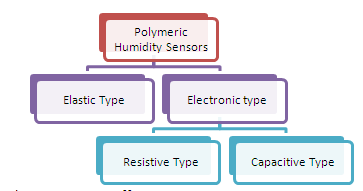
Fig. 3: A Block Diagram Explaining Different Categories of a Polymeric Humidity Sensors
Sensors based on capacitive effect:
Humidity sensors relying on this principle consists of a hygroscopic dielectric material sandwiched between a pair of electrodes forming a small capacitor. Most capacitive sensors use a plastic or polymer as the dielectric material, with a typical dielectric constant ranging from 2 to 15. In absence of moisture, the dielectric constant of the hygroscopic dielectric material and the sensor geometry determine the value of capacitance.
At normal room temperature, the dielectric constant of water vapor has a value of about 80, a value much larger than the constant of the sensor dielectric material. Therefore, absorption of water vapor by the sensor results in an increase in sensor capacitance.
At equilibrium conditions, the amount of moisture present in a hygroscopic material depends on both the ambient temperature and the ambient water vapor pressure. This is true also for the hygroscopic dielectric material used on the sensor.
By definition, relative humidity is a function of both the ambient temperature and water vapor pressure. Therefore there is a relationship between relative humidity, the amount of moisture present in the sensor, and sensor capacitance. This relationship governs the operation of a capacitive humidity instrument.
Basic structure of capacitive type humidity sensor is shown below:
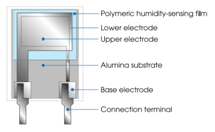
Fig. 4: A Figure Illustrating the Basic Structure of a Capacitive Type Humidity Sensor
On Alumina substrate, lower electrode is formed using gold, platinum or other material. A polymer layer such as PVA is deposited on the electrode. This layers senses humidity. On top of this polymer film, gold layer is deposited which acts as top electrode. The top electrode also allows water vapour to pass through it, into the sensing layer . The vapors enter or leave the hygroscopic sensing layer until the vapour content is in equilibrium with the ambient air or gas.Thus capacitive type sensor is basically a capacitor with humidity sensitive polymer film as the dielectric.
Sensors based on Resistive effect:
Resistive type humidity sensors pick up changes in the resistance value of the sensor element in response to the change in the humidity. Basic structure of resistive type humidity sensor from TDK is shown below
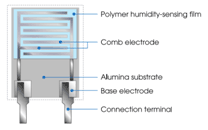
Fig. 5: A Figure Illustrating the Basic Structure of a Resistive Type Humidity Sensor
Thick film conductor of precious metals like gold, ruthenium oxide is printed and calcinated in the shape of the comb to form an electrode. Then a polymeric film is applied on the electrode; the film acts as a humidity sensing film due to the existence of movable ions. Change in impedance occurs due to the change in the number of movable ions.
Pros and Cons
Pros and Cons:
Capactive type sensors are very linear and hence can measure RH from 0% to 100%, but require complex circuit and also need regular calibration. Resistive type sensors find difficulty in measuring low values (below 5%RH) , the change is impedance is too high and hence it is difficult to control the dynamics, temperature effects the properties significantly. However, advances in electronics can mitigate the problems of temperature effects and high impedance change.
Capacitive RH sensors dominate both atmospheric and process measurements and are the only types of full-range RH measuring devices capable of operating accurately down to 0% RH. Because of their low temperature effect, they are often used over wide temperature ranges without active temperature compensation. Thermoset polymer-based capacitive sensors, as opposed to thermoplastic-based capacitive sensors, allow higher operating temperatures and provide better resistivity against chemical liquids and vapors such as isopropyl, benzene, toluene, formaldehydes, oils, common cleaning agents, etc.
Other Humidity Sensing Mechanisms:
1. Coulometric
An electrolyte is formed by absorption of water and the current level obtained is proportional to the moisture content.
2. Gravimetric
A volume of moist air is exposed to a drying agent and subsequently weighed. The weight corresponds to the moisture.
3. Microwave/Infrared:
Attenuation of the transmitted signal varies as the amount of water content increases is an indication of the moisture content in the medium.
4. Dry-and Wet bulb temperature
Psychrometer gives relative humidity estimates based on Dry-and Wet bulb temperature measurement
5. Dew Point
Dew Point hygrometers measure dew-point temperature by detecting dew formation on a cooler base.
Characteristics
HUMIDITY SENSORS – CHARACTERISTICS
Sensor characterisation is done based on the n-point(usually 9) characterisation of the sensor. Characterisation is performed at a specific temperature (25°C) and excitation.
In 9 point characterisation method, humidity levels are swept the through the RH values and measuring the corresponding dc output voltage for the individual sensor: Values are taken at humidity levels of 0%, 25%, 53.2%, 75.3%, 93.8%, 75.3%, 53.2%, 25% and 0%. Based on the characterisation results, Best Fit Straight Line (BFSL) is plotted and sensor characteristics are specified in the datasheets.
. Acuracy
Accuracy is specified based on the specific calibration curves for any individual sensor. It is specified using the linear Best Fit Straight Line (BFSL) and the non-linear 2nd order curve.
As an example let us consider a sensor with an accuracy of ±2% RH (BFSL). If the sensor has an output voltage of 0.689 V at 0%RH, an average slope(BFSL) of 0.036 V/%RH and offset of 0.662, then its BFSL accuracy error is given by (0.689 – 0.662)/0.036 = 0.75% RH. As sensors accuracy is ±2% RH (BFSL), i.e. 0.072V, the sensor should always output 0.662 ±0.072 V or a value in the range of 0.59 V to 0.734 V.
· Hysteresis
· Hysteresis is the difference between the two voltages to %RH conversions (using average BFSL slope) at each of the four duplicated points in the nine point characterization. Hysteresis is recorded in absolute %RH terms.
The value taken is the largest %RH figure for an individual sensor over each of the four characterization points.
· Interchangeability
Interchangeability defines the range of voltages for any population of sensors at this RH point.
As an example let us consider a sensor from a particular company with an interchangeabilty of ±5% at 0% RH. With an average slope (BFSL) of 0.036 V/%RH and offset of 0.662 V, ±5% RH is equal to ±0.18 V. This means that the output voltage for this device is 0.662 V ±0.18 V, or a range of 0.482V to 0.842 V. When exposed to an RH of 0%, the output of the entire population of sensors will fall within this range.
· Linearity
Linearity indicates the voltage deviation from the BFSL value and the measured output voltage value, converted to RH.
· Reliability
Sensors are subjected to accelerated stress tests. If the tests causes the sensor to drift and report RH outside prescribed specifications, the sensor is considered a failed sensor. Based on such tests, reliability figures like MTTF(Mean-time-to-failure) and FIT (Number of Failures per billion operating hours) are specified.
. Repeatability
Repeatability is the maximum variation between sensor outputs for repeated sweeps of humidity levels across the sensors’ measurement range under identical conditions.
For example, if the point value is 0.013 V using the 31 mV/RH slope this is 0.42% RH.
· Response Time
Response Time is measured in “slow moving air” (less than 5 m/s). Typically, maximum time required for the output voltage of the sensor to rise to 63% of its final value or to fall to 37% of its final value when exposed to a step rise or fall in humidity is specified as response time
· Temperature Compensation
Voltage output for an individual sensor at a given excitation and RH is affected by temperature. In many sensors, the temperature is measured and the effect of temperature of humidity measurement is reduced and this is referred to as temperature compensation.
· Stability
Output voltage stability is the output voltage drift in time at the specified RH level converted to a %RH value.
This figure is also generated through accelerated stress tests and is typically taken as the change in mean output voltage from a large batch of sensors in specific environmental conditions.
SELECTING A HUMIDITY SENSOR
As there no real physical standard for relative humidity calibration, humidity instruments are not specified properly. And it makes it really difficult for a user to compare the sensors from different manufacturers. This makes it mandatory for a user to go deeper into the specifications and attempt to verify the claims of the instrument manufacturer. Various sensor characteristics, viz., accuracy, linearity, hysteresis, calibration errors, long term stability of sensor and electronics, needs to be examined using the support documentation from the OEM.
Filed Under: Articles

Questions related to this article?
👉Ask and discuss on Electro-Tech-Online.com and EDAboard.com forums.
Tell Us What You Think!!
You must be logged in to post a comment.