Wireless Power Transmission

Description

Contributor: 
Srinvas Arun Tej P

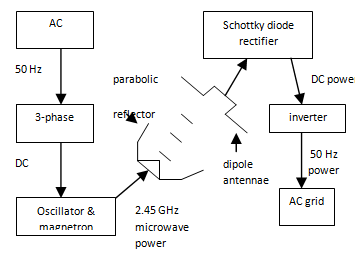
The technology for wireless power transmission or wireless power transfer (WPT) is in the forefront of electronic development. Applications involving microwaves, solar cells, lasers, and resonance of electromagnetic waves have had the most recent success with WPT.  The main function of wireless power transfer is to allow electrical devices to be continuously charged and lose the constraint of a power cord.  Although the idea is only a theory and not widely implemented yet, extensive research dating back to the 1850’s has led to the conclusion that WPT is possible. Wireless Power Transmission, Transfer The three main systems used for WPT are microwaves, resonance, and solar cells. Microwaves would be used to send electromagnetic radiation from a power source to a receiver in an electrical device. 


The concept of resonance causes electromagnetic radiation at certain frequencies to cause an object to vibrate.  This vibration can allow energy to be transmitted between the two vibrating sources.  Solar cells, ideally, would use a satellite in space to capture the suns energy and send the energy back to Earth.  This concept would help to solve the major energy crisis currently concerning most of the world.  These ideas would work perfectly in theory, but converting the radio frequencies into electrical power and electrical power to radio frequencies are two main problems that are withholding this idea to become reality. This paper will explore the technological applications of microwaves, resonance, and solar cells in WPT and explain the basic technique of  transmitting power wirelessly. It will also include problems encountered during experimentation and recent advances in the field. The paper will also include the futuristic applications of WPT and its ability to solve the energy crisis.

 
The Beginning Of Wireless Power Transmission
Electricity by today’s standards is considered an essential to life.  Electricity has been the fuel for technological development since its first applications dating back to the late 16th century.  This marvellous phenomenon, however, comes with a price.  The cost of making electricity is harmful to the environment. The Energy Information Administration’s records show that nearly 50% of all electrical plants are high polluting coal plants. Major changes in the environment have occurred over the last 30 years that are detrimental to the future of this planet.  If this path is left unchanged, scientists have predicted that certain parts of the world could be uninhabitable by 2050. The solution is to reduce greenhouse gas emissions into earth’s atmosphere through alternative power generation.  One sustainable technology leading this charge is wireless power transfer (WPT).
 
The concept of wireless power transmission has been around since the mid 17th century.  WPT is exactly what the name states; to transfer electrical power from a source to a device without the aid of wires.  The founder of AC electricity, Nikola Tesla, was first to conduct experiments dealing with WPT.  His initial experiment of lighting gas discharge lamps from over 25 miles away, wirelessly, was a success.  His idea came from the notion that earth itself is a conductor that can carry a charge throughout the entire surface. Although his idea of a world system of WPT could never be properly funded, his initial research sparked the scientific world into a whole new theory of power generation.  While Tesla’s experiments were not creating electricity, but just transferring it, his ideas can be applied to solve our energy crisis.  His experiments sparked new ideas such as applications involving microwaves, lasers, resonance and solar cells.  Each application has its respective drawbacks but also has the potential to aid this planet in its dying need for an alternative to creating power.
 
Today, portable technology is a part of every day life. Most commonly used devices no longer need to draw power from the supply continuously. But from portability emerges another challenge: energy. Almost all portable devices are battery powered, meaning that eventually, they all must be recharged–using the wired chargers currently being used. Now instead of plugging in a cell phone, PDA, digital camera, voice recorder, mp3 player or laptop to recharge it, it could receive its power wirelessly–quite literally, “out of thin air”.


Comments (6)

good work

good work

hey.. good work.i want more

hey.. good work.

i want more detail on it..

i want to make it.

plz mail me detail of it. on: pratikparmar.ec@gmail.com


PR@T!K

Hi, These are the 2 circuits

Hi,


These are the 2 circuits done by me


Low Cost Wireless Cellphone Charger With Circuit Diagram

http://cooltricksplus.blogspot.in/2013/04/low-cost-wireless-cellphone-charger.html


Wireless Power Transmission with circuit diagram

http://cooltricksplus.blogspot.in/2013/04/fun-with-wireless-power_12.html

Hi, These are the 2 circuits

Hi,


These are the 2 circuits done by me


Low Cost Wireless Cellphone Charger With Circuit Diagram

cooltricksplus.blogspot.in/2013/04/low-cost-wireless-cellphone-charger.html


Wireless Power Transmission with circuit diagram

cooltricksplus.blogspot.in/2013/04/fun-with-wireless-power_12.html

Awesome work Can i have some

Awesome work


Can i have some more details about it like will this circuit work under water, Also i need to know different methodoligies involved in power transsmission. U can mail me to heramban@gmail.com


Regards

Heramban


  Will this circuit work


Will this circuit work under water need more deails plz.....


heramban@gmail.com. This is my mail ID. I also need more details like the various metods availabe for power transmission

Well done

Well done

hey good job!! can u send

hey good job!!


can u send some circuit diagrams of wireless power transmission to

my mail

s.thejeshwarkumar@gmail.com

really nice 

really nice