Engineers Garage

  • Electronic Projects & Tutorials
    • Electronic Projects
      • Arduino Projects
      • AVR
      • Raspberry pi
      • ESP8266
      • BeagleBone
      • 8051 Microcontroller
      • ARM
      • PIC Microcontroller
      • STM32
    • Tutorials
      • Sensor Series
      • 3D Printing
      • AI
      • ARDUINO Compatible Coding
      • Audio Electronics
      • Battery Management
      • Beginners Electronics Series
      • Brainwave
      • Digital electronics (DE)
      • Electric Vehicles
      • EMI/EMC/RFI
      • EVs
      • Hardware Filters
      • IoT tutorials
      • LoRa/LoRaWAN
      • Power Tutorials
      • Protocol
      • Python
      • RPI Python Programming
      • Sensors
      • USB
      • Thermal management
      • Verilog
      • VHDL
    • Circuit Design
    • Project Videos
    • Components
  • Articles
    • Tech Articles
    • Insight
    • Invention Stories
    • How to
    • What Is
  • News
    • Electronic Product News
    • Business News
    • Company/Start-up News
    • DIY Reviews
    • Guest Post
  • Forums
    • EDABoard.com
    • Electro-Tech-Online
    • EG Forum Archive
  • DigiKey Store
    • Cables, Wires
    • Connectors, Interconnect
    • Discrete
    • Electromechanical
    • Embedded Computers
    • Enclosures, Hardware, Office
    • Integrated Circuits (ICs)
    • Isolators
    • LED/Optoelectronics
    • Passive
    • Power, Circuit Protection
    • Programmers
    • RF, Wireless
    • Semiconductors
    • Sensors, Transducers
    • Test Products
    • Tools
  • Learn
    • eBooks/Tech Tips
    • Design Guides
    • Learning Center
    • Tech Toolboxes
    • Webinars & Digital Events
  • Resources
    • Digital Issues
    • EE Training Days
    • LEAP Awards
    • Podcasts
    • Webinars / Digital Events
    • White Papers
    • Engineering Diversity & Inclusion
  • Guest Post Guidelines
  • Advertise
  • Subscribe

How to Find Resistance of Anything using Wheatstone Bridge

By Salman Khan August 1, 2013


Finding a resistance is very easy all you have to do is only putting a particular type of resistors into it.

What is resistance of the any given material?

Resistance is the ability to stop down the flow of current through them.

Which Theory used to find the resistance?

Wheatstone bridge is used to find the resistance.


What is Wheatstone bridge?

A Wheatstone bridge is an electrical circuit used to measure an unknown electrical resistance by balancing two legs of a bridge circuit, one leg of which includes the unknown component. Its operation is similar to the original potentiometer. It was invented by Samuel Hunter Christie in 1833 and improved and popularized by Sir Charles Wheatstone in 1843. One of the Wheatstone bridge’s initial uses was for the purpose of soils analysis and comparison. 

Aim: To find out the resistance for a carbon resistor.                                             


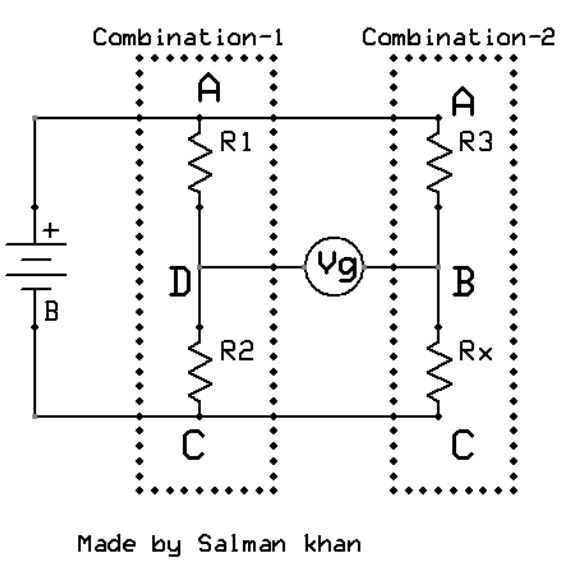
Theory:  The ratio of the 1st combination of resistor is equal to the ratio of 2nd ­combination of resistor. (You will understand it later on when you will see the below diagram.)

Derivation:

First, Kirchhoff’s first rule is used to find the currents in junctions B and D:
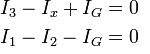
Wheatstone Bridge


Then, Kirchhoff’s second rule is used for finding the voltage in the loops ABD and BCD:

Wheatstone Bridge


When the bridge is balanced, then IG = 0, so the second set of equations can be rewritten as: 

Wheatstone Bridge

Then, the equations are divided and rearranged, giving:

Wheatstone Bridge

From the first rule, I3 = Ix and I1 = I2. The desired value of Rx is now known to be given as:

Wheatstone Bridge

If all four resistor values and the supply voltage (VS) are known, and the resistance of the galvanometer is high enough that IG is negligible, the voltage across the bridge (VG) can be found by working out the voltage from each potential divider and subtracting one from the other. The equation for this is:

Voltage through Wheatstone Bridge Method


where VG is the voltage of node B relative to node D.

Material required:

Scale, iron element wire, Few combination of resistor, connecting wire, Voltmeter (I use multimeter).

 Procedure

Procedure:

1.      Take a scale (I use stainless steel scale).

2.     Wrap it with tape so that it could not conduct.

Find Resistance of anything


3.      Now take iron element

Find resitance of anything


4.      Tie it as shown in figure.


Find resistance of anything


Find resistance of anything

5.     Connect the wires and resistor in the scale.


Find resistance

6.     Connect the multi meter according to circuit given above.


How to find resistance of anything

7.     Connect the battery’s wire in the scale’s wire. Positive to one end and negative to second end.

8.      Set the multimeter till the milivoltage becomes zero or almost zero.

9.     Take the reading of the scale.

10.  The positive wire should be connected to the known resistor. And negative should be with unknown resistor. You can also see in the circuit.

11.  The length of wire between the positive and the multimeter wire is R1. And the length of the wire between the negative and the galvanometer wire is R2.

12. Now last step to be done and find the resistance of the unknown resistance.

13.  My multimeter reading goes till 0.6v and then I read that the R1 is 10 and R2 is rest 20.

How to find of resistance of anything

14. Now calculate it.


Finding resistance

The resistance of the unknown resistor is 36 Ohm.

Advantages:

          1.      This is the safest method or you can say easier method to work in this.

          2.      Can find very small resistance and can also find very high resistance by changing the value of current.                    

          3.      Does not require any heavy metals.      

          4.      Very eco friendly.   

          5.     No pollution.

Disadvantages:

         1.      This gives you precise value you cannot use it that appliances which will give requires exact amount of resistor.  

         2.      If the wire is not connected properly from anywhere you will get the value properly.           

         3.       Any mistake can lead to a high injure to health.

         4.      Always wear insulator while working with high voltage to find the high resistance. If forgot can lead to the electric shock.

                New user always find the value wrong so first find the known resistance and when you will feel that now you find the value than you can           find the value of unknown resistance.

         So work hard and when you are used to it you will feel very easy to do it so.


Project Source Code


Circuit Diagrams
Find-resistance-of-anything


Filed Under: Electronic Projects
Tagged With: resistance, wheatstone bridge
 

Next Article

← Previous Article
Next Article →

Questions related to this article?
👉Ask and discuss on EDAboard.com and Electro-Tech-Online.com forums.


Tell Us What You Think!! Cancel reply

You must be logged in to post a comment.

Submit a Guest Post

submit a guest post

EE TECH TOOLBOX

“ee
Tech Toolbox: Power Efficiency
Discover proven strategies for power conversion, wide bandgap devices, and motor control — balancing performance, cost, and sustainability across industrial, automotive, and IoT systems.

EE Learning Center

EE Learning Center
“engineers
EXPAND YOUR KNOWLEDGE AND STAY CONNECTED
Get the latest info on technologies, tools and strategies for EE professionals.

HAVE A QUESTION?

Have a technical question about an article or other engineering questions? Check out our engineering forums EDABoard.com and Electro-Tech-Online.com where you can get those questions asked and answered by your peers!


RSS EDABOARD.com Discussions.

  • CST Studio Suite 2021 – New Project Window Shows Black Screen
  • Introduction to the Principle of Human Detection by Millimeter-Wave Radar Modules
  • Biasing an AC signal
  • SiC FET turn-off in 2000W PFC
  • Why SG3525 + TL431 + PC817 feedback is not working on ±35 V push-pull SMPS?

RSS Electro-Tech-Online.com Discussions

  • restarting this Christmas project
  • desoldering
  • Unknown, to me, electric motor fitting
  • Can a small solar panel safely trickle-charge old NiMH AA batteries?
  • KiCad custom symbol definition correct approach

Featured Tutorials

Real Time Hardware Filter Design

  • Practical implementation of bandpass and band reject filters
    Practical implementation of bandpass and band reject filters
  • Practical application of hardware filters with real-life examples
    Practical application of hardware filters with real-life examples
  • A filter design example
    A filter design example
  • Types of filter responses
    Types of filter responses
  • What are the two types of hardware filters?
    What are the two types of hardware filters?
  • What are hardware filters and their types?
    What are hardware filters and their types?
More Tutorials >

Recent Articles

  • Taiwan Semiconductor adds 24-V automotive TVS devices
  • ST e-fuse controller enables fast, flexible automotive power protection
  • Posifa sensors improve low-flow accuracy in compact systems
  • Acopian releases low-profile power supplies rated to 900 W
  • Octavo Systems OSDZU-3 REF Development Platform

EE ENGINEERING TRAINING DAYS

engineering
Engineers Garage
  • Analog IC TIps
  • Connector Tips
  • Battery Power Tips
  • EDABoard Forums
  • EE World Online
  • Electro-Tech-Online Forums
  • EV Engineering
  • Microcontroller Tips
  • Power Electronic Tips
  • Sensor Tips
  • Test and Measurement Tips
  • 5G Technology World
  • Subscribe to our newsletter
  • About Us
  • Contact Us
  • Advertise

Copyright © 2025 WTWH Media LLC. All Rights Reserved. The material on this site may not be reproduced, distributed, transmitted, cached or otherwise used, except with the prior written permission of WTWH Media
Privacy Policy

Search Engineers Garage

  • Electronic Projects & Tutorials
    • Electronic Projects
      • Arduino Projects
      • AVR
      • Raspberry pi
      • ESP8266
      • BeagleBone
      • 8051 Microcontroller
      • ARM
      • PIC Microcontroller
      • STM32
    • Tutorials
      • Sensor Series
      • 3D Printing
      • AI
      • ARDUINO Compatible Coding
      • Audio Electronics
      • Battery Management
      • Beginners Electronics Series
      • Brainwave
      • Digital electronics (DE)
      • Electric Vehicles
      • EMI/EMC/RFI
      • EVs
      • Hardware Filters
      • IoT tutorials
      • LoRa/LoRaWAN
      • Power Tutorials
      • Protocol
      • Python
      • RPI Python Programming
      • Sensors
      • USB
      • Thermal management
      • Verilog
      • VHDL
    • Circuit Design
    • Project Videos
    • Components
  • Articles
    • Tech Articles
    • Insight
    • Invention Stories
    • How to
    • What Is
  • News
    • Electronic Product News
    • Business News
    • Company/Start-up News
    • DIY Reviews
    • Guest Post
  • Forums
    • EDABoard.com
    • Electro-Tech-Online
    • EG Forum Archive
  • DigiKey Store
    • Cables, Wires
    • Connectors, Interconnect
    • Discrete
    • Electromechanical
    • Embedded Computers
    • Enclosures, Hardware, Office
    • Integrated Circuits (ICs)
    • Isolators
    • LED/Optoelectronics
    • Passive
    • Power, Circuit Protection
    • Programmers
    • RF, Wireless
    • Semiconductors
    • Sensors, Transducers
    • Test Products
    • Tools
  • Learn
    • eBooks/Tech Tips
    • Design Guides
    • Learning Center
    • Tech Toolboxes
    • Webinars & Digital Events
  • Resources
    • Digital Issues
    • EE Training Days
    • LEAP Awards
    • Podcasts
    • Webinars / Digital Events
    • White Papers
    • Engineering Diversity & Inclusion
  • Guest Post Guidelines
  • Advertise
  • Subscribe