Engineers Garage

  • Electronic Projects & Tutorials
    • Electronic Projects
      • Arduino Projects
      • AVR
      • Raspberry pi
      • ESP8266
      • BeagleBone
      • 8051 Microcontroller
      • ARM
      • PIC Microcontroller
      • STM32
    • Tutorials
      • Complete Sensor Guide
      • Engineering Deep Dives
      • AI
      • ARDUINO Compatible Coding
      • Audio Electronics
      • Battery Management
      • Beginners Electronics Series
      • Brainwave
      • Digital electronics (DE)
      • Electric Vehicles
      • EMI/EMC/RFI
      • EVs
      • Hardware Filters
      • IoT tutorials
      • LoRa/LoRaWAN
      • Power Tutorials
      • Protocol
      • Python
      • RPI Python Programming
      • Sensors
      • USB
      • Thermal management
      • Verilog
      • VHDL
    • Circuit Design
    • Project Videos
    • Components
  • Articles
    • Tech Articles
    • Insight
    • Invention Stories
    • How to
    • What Is
  • News
    • Electronic Product News
    • Business News
    • Company/Start-up News
    • DIY Reviews
    • Guest Post
  • Forums
    • EDABoard.com
    • Electro-Tech-Online
    • EG Forum Archive
  • DigiKey Store
    • Cables, Wires
    • Connectors, Interconnect
    • Discrete
    • Electromechanical
    • Embedded Computers
    • Enclosures, Hardware, Office
    • Integrated Circuits (ICs)
    • Isolators
    • LED/Optoelectronics
    • Passive
    • Power, Circuit Protection
    • Programmers
    • RF, Wireless
    • Semiconductors
    • Sensors, Transducers
    • Test Products
    • Tools
  • Learn
    • Design Guides
    • Learning Center
    • Tech Toolboxes
    • Tech Terms
    • Webinars & Digital Events
  • Resources
    • EE Training Days
    • LEAP Awards
    • Podcasts
    • White Papers
  • Guest Post Guidelines
  • Advertise
  • Subscribe

Sealed Maintenance Free (SMF) Batteries

By D.Mohankumar April 21, 2008

Sealed Maintenance Free batteries are widely used where minimal maintenance and space requirements are the main considerations. In UPS systems, it is used because of its maintenance free and eco friendly features. SMF batteries do not require water and acid top up and are totally maintenance free. There is no water loss during the charge- discharge cycle and the battery works on the oxygen recombination principle. SMF battery is also called as Valve Regulated Lead Acid or VRLA battery.

 
The important features of SMF battery are
1. It is compact and can be oriented in any position like vertical, horizontal etc.
2. There is no fume or smell from the battery since the acid is in gel form.
3. The battery can be installed in the equipment prior to transportation since there is no leakage or water spill during transportation.
4. More economical than any other forms of battery.
Based on the use, the SMF battery is classified into three types of batteries.
 
[header = Various SMF Batteries]
 
Types of SMF Batteries
1. 6 Volt 4.5 Ah type
These are used in Emergency light applications and telecom instruments. These are small sized with 4.5 Ampere hour current capability.
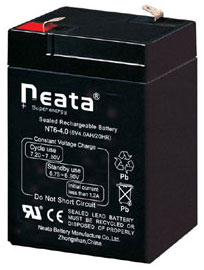
6V SMF Battery
Emergency Lamp 6V battery
 
2. 12 Volt 7.2 Ah type
This type is used in offline UPS and can deliver much current.
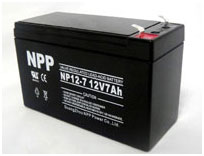
12V SMF Battery
12 Volt UPS Battery
 
3. Big type
Big type SMF battery is used in Online UPS.
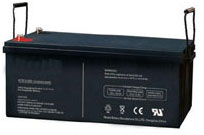
Big SMF Battery
 
New forms of SMF batteries are being designed to get better performance and cost effective. Some of the specially designed batteries include Deep discharge battery for longer cyclic life, high discharge battery, Front access battery to monitor the terminal voltage, Gel type battery for longer cyclic life and temperature tolerance etc.
 
[header = Long Cycle Life]
 
Long Cyclic life
SMF battery is totally maintenance free and has longer cyclic life, thus compensating the initial higher cost. One of the important aspects of battery life in relation to the use of equipment is the cut off voltage set in the equipment. For example in inverter systems using high current batteries like 150Ah, a cut off voltage less than 10.5 volts can shorten the life of the battery. If the cut off voltage is set as 11.5 volts, it will increase the battery life since the battery is not entering into the deep discharge state.
 
In the SMF battery, the chemical recombination occurs in the Positive plate as per the following equation
H2O = ½ O2 + 2H+ + 2e-
In the Negative plate, the reaction occurs as
2Pb + O2 = 2PbO
PbO + H2SO4 = PbSO4 + H2O
PbSO4+2e- + 2H+ =Pb + H2SO4
 
During the chemical reaction, oxygen evolved from the positive plate recombines at the negative plate and suppress the formation of hydrogen. This prevents gas accumulation inside the battery.  So SMF Battery is clean and Eco-friendly. Moreover there is no free acid or electrolyte in the battery, so that the battery can be placed in any position. There is an Absorbed Glass Mat or AGM inside the battery that holds the acid. The acid is thus in an immobilized form as gel. In order to avoid excess pressure and battery explosion, vent valves are provided to release the pressure inside the battery.
 
[header = How to Optimize SMF battery performance]
 
How to optimize the SMF battery performance?
In order to increase the life of battery, it is necessary to monitor the battery performance constantly. Here are some tips to optimize the battery performance.
1. The SMF battery should be placed in well ventilated area to avoid high temperature environment. With each 10 degree rise in air temperature, the float life reduces to half. If the battery is installed in equipment, it is necessary to isolate it from heat generating components like transformer.
2. In order to prevent deep discharge, it is necessary to set the cut off voltage to 11.5 volts in 12 volt battery and 4.5 in 6 volt battery.
3. It is necessary to prevent no load battery drain. The additional components of the equipment such as sensors, displays and indicators consume power in the no load condition. So if the equipment is not provided with automatic charging, this power loss leads to deep discharge.
4. Boost cum float charging is suitable for SMF battery. If the power failure is frequent, the battery should be charged immediately to acquire full charge before the next power failure.
5. If there is any problem such as low backup time, battery heating, low terminal voltage even after continuous charging develops, the battery should be attended immediately.
6. If the equipment is not using for long time, it should be charged once in every week. If the battery is allowed to charge and discharge frequently, its life can be extended to 3-5 years.
 

Filed Under: Electronic Projects


Next Article

← Previous Article
Next Article →

Questions related to this article?
👉Ask and discuss on Electro-Tech-Online.com and EDAboard.com forums.


Tell Us What You Think!! Cancel reply

Log in to leave a comment:

Lost your password?

Don't have an account? Register here

Submit a Guest Post

submit a guest post

EE TECH TOOLBOX

“ee
Tech Toolbox: Wide Bandgap Semiconductors
Moving from silicon to GaN or SiC feels like a whole new ballgame, doesn’t it? It isn’t just about faster switching; it’s about managing the layout parasitics and thermal realities that come with that speed. This month’s Tech Toolbox features a curated eBook that tackles these design hurdles head-on.

EE Learning Center

EE Learning Center
“engineers
EXPAND YOUR KNOWLEDGE AND STAY CONNECTED
Get the latest info on technologies, tools and strategies for EE professionals.

HAVE A QUESTION?

Have a technical question about an article or other engineering questions? Check out our engineering forums EDABoard.com and Electro-Tech-Online.com where you can get those questions asked and answered by your peers!


RSS feed: EDABOARD.com Discussions. EDABOARD.com Discussions.

  • lm393 comparator
  • Unipolar Current sense in sinusoidal bridge current driver
  • How to do 2-level pulley/belt system for a UGV ?
  • I have an Acer Aspire 5 A515-54G-53H6 issue with mother board
  • Twisted pair modelling in Cadence

RSS feed: Electro-Tech-Online.com Discussions Electro-Tech-Online.com Discussions

  • Problem connecting to Starlink
  • DBT alternative idea
  • Smoothing out Resistive Power Draw with PWM
  • remote ATX PSU turn on
  • Flippin bin.

Featured Tutorials

VHDL Series (1-24)

  • VHDL Tutorial 17: Design a JK flip-flop (with preset and clear) using VHDL
    VHDL Tutorial 17: Design a JK flip-flop (with preset and clear) using VHDL
  • VHDL Tutorial 18: Design a T flip-flop (with enable and an active high reset input) using VHDL
    VHDL Tutorial 18: Design a T flip-flop (with enable and an active high reset input) using VHDL
  • VHDL Tutorial – 19: Designing a 4-bit binary counter using VHDL
    VHDL Tutorial – 19: Designing a 4-bit binary counter using VHDL
  • VHDL Tutorial – 20: Designing 4-bit binary-to-gray & gray-to-binary code converters
    VHDL Tutorial – 20: Designing 4-bit binary-to-gray & gray-to-binary code converters
  • VHDL Tutorial – 21: Designing an 8-bit, full-adder circuit using VHDL
    VHDL Tutorial – 21: Designing an 8-bit, full-adder circuit using VHDL
  • VHDL Tutorial – 22: Designing a 1-bit & an 8-bit comparator by using VHDL
    VHDL Tutorial – 22: Designing a 1-bit & an 8-bit comparator by using VHDL
More Tutorials >

Recent Articles

  • Diodes introduces automotive rectifiers from 2 A to 8 A
  • Advanced Energy launches 160 W ruggedized power supply
  • Bel Fuse converters support railway power systems
  • August Engineering Deep Dive
  • Littelfuse TVS diodes protect 270 V–800 V power systems

EE ENGINEERING TRAINING DAYS

engineering
Engineers Garage
  • Analog IC TIps
  • Connector Tips
  • Battery Power Tips
  • EDABoard Forums
  • EE World Online
  • Electro-Tech-Online Forums
  • EV Engineering
  • Microcontroller Tips
  • Power Electronic Tips
  • Sensor Tips
  • Test and Measurement Tips
  • 5G Technology World
  • Subscribe to our newsletter
  • About Us
  • Contact Us
  • Advertise

Copyright © 2026 Arrowfly LLC. All Rights Reserved. The material on this site may not be reproduced, distributed, transmitted, cached or otherwise used, except with the prior written permission of Arrowfly
Privacy Policy

Search Engineers Garage

  • Electronic Projects & Tutorials
    • Electronic Projects
      • Arduino Projects
      • AVR
      • Raspberry pi
      • ESP8266
      • BeagleBone
      • 8051 Microcontroller
      • ARM
      • PIC Microcontroller
      • STM32
    • Tutorials
      • Complete Sensor Guide
      • Engineering Deep Dives
      • AI
      • ARDUINO Compatible Coding
      • Audio Electronics
      • Battery Management
      • Beginners Electronics Series
      • Brainwave
      • Digital electronics (DE)
      • Electric Vehicles
      • EMI/EMC/RFI
      • EVs
      • Hardware Filters
      • IoT tutorials
      • LoRa/LoRaWAN
      • Power Tutorials
      • Protocol
      • Python
      • RPI Python Programming
      • Sensors
      • USB
      • Thermal management
      • Verilog
      • VHDL
    • Circuit Design
    • Project Videos
    • Components
  • Articles
    • Tech Articles
    • Insight
    • Invention Stories
    • How to
    • What Is
  • News
    • Electronic Product News
    • Business News
    • Company/Start-up News
    • DIY Reviews
    • Guest Post
  • Forums
    • EDABoard.com
    • Electro-Tech-Online
    • EG Forum Archive
  • DigiKey Store
    • Cables, Wires
    • Connectors, Interconnect
    • Discrete
    • Electromechanical
    • Embedded Computers
    • Enclosures, Hardware, Office
    • Integrated Circuits (ICs)
    • Isolators
    • LED/Optoelectronics
    • Passive
    • Power, Circuit Protection
    • Programmers
    • RF, Wireless
    • Semiconductors
    • Sensors, Transducers
    • Test Products
    • Tools
  • Learn
    • Design Guides
    • Learning Center
    • Tech Toolboxes
    • Tech Terms
    • Webinars & Digital Events
  • Resources
    • EE Training Days
    • LEAP Awards
    • Podcasts
    • White Papers
  • Guest Post Guidelines
  • Advertise
  • Subscribe