Engineers Garage

  • Electronic Projects & Tutorials
    • Electronic Projects
      • Arduino Projects
      • AVR
      • Raspberry pi
      • ESP8266
      • BeagleBone
      • 8051 Microcontroller
      • ARM
      • PIC Microcontroller
      • STM32
    • Tutorials
      • Sensor Series
      • 3D Printing
      • AI
      • ARDUINO Compatible Coding
      • Audio Electronics
      • Battery Management
      • Beginners Electronics Series
      • Brainwave
      • Digital electronics (DE)
      • Electric Vehicles
      • EMI/EMC/RFI
      • EVs
      • Hardware Filters
      • IoT tutorials
      • LoRa/LoRaWAN
      • Power Tutorials
      • Protocol
      • Python
      • RPI Python Programming
      • Sensors
      • USB
      • Thermal management
      • Verilog
      • VHDL
    • Circuit Design
    • Project Videos
    • Components
  • Articles
    • Tech Articles
    • Insight
    • Invention Stories
    • How to
    • What Is
  • News
    • Electronic Product News
    • Business News
    • Company/Start-up News
    • DIY Reviews
    • Guest Post
  • Forums
    • EDABoard.com
    • Electro-Tech-Online
    • EG Forum Archive
  • DigiKey Store
    • Cables, Wires
    • Connectors, Interconnect
    • Discrete
    • Electromechanical
    • Embedded Computers
    • Enclosures, Hardware, Office
    • Integrated Circuits (ICs)
    • Isolators
    • LED/Optoelectronics
    • Passive
    • Power, Circuit Protection
    • Programmers
    • RF, Wireless
    • Semiconductors
    • Sensors, Transducers
    • Test Products
    • Tools
  • Learn
    • eBooks/Tech Tips
    • Design Guides
    • Learning Center
    • Tech Toolboxes
    • Webinars & Digital Events
  • Resources
    • Digital Issues
    • EE Training Days
    • LEAP Awards
    • Podcasts
    • Webinars / Digital Events
    • White Papers
    • Engineering Diversity & Inclusion
  • Guest Post Guidelines
  • Advertise
  • Subscribe

Smoke Detectors / Sensor

By Anshul Thakur March 26, 2012


Where there’s smoke, there’s fire and we usually don’t amuse ourselves with the idea of having a fire anywhere else other than a fireplace. So, we equip ourselves with an arsenal of early detection sensors that can help avert a potential disaster to life and property. One of the chief whistleblowers in this assortment of accident prevention devices is the smoke detector, which we can often see as round perforated plastic disks, fixed to the ceilings of offices and homes.
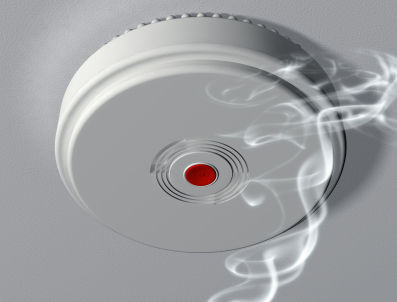
A smoke detector, in all its simplicity, detects smoke in its surroundings and sounds an alarm. A Representational Image of a Smoke Detector
Fig. 1: A Representational Image of a Smoke Detector
 
These are one of the most important safety devices in an establishment especially in homes, where it is one of the few sensors which can provide safety 24×7. The alarm issued may manifest itself as a Blinking LED, an Audio siren, or in case of establishments connected with a central monitoring station, an alert on the management screens in the control room.
 
If a smoke detector is to be considered to be a fire alarm, then the credit of inventing the first automatic electric fire alarm goes to Francis Robbins Upton in the year 1902. Otherwise, George Andrew Darby holds the patent for the first electrical heat and smoke detector. In 1930, a Swiss physicist Walter Jaeger accidentally discovered the phenomena of smoke detection through ionization. But it was in 1965 that the first truly affordable smoke detector with replaceable batteries was invented. This paved the way for commercialization of smoke detectors as we know of them today. In early 1980s solid state circuitry replaced cathode tubes, significantly reducing the size of alarms and also the costs. The effect has been such that the fatalities from fire in home which used to be around 10,000 per year dropped drastically to less than 6000 per year in early 90s.
The area of utility determines the scope of smoke detectors. A small area, like a household, does not need many smoke detectors and the setting off of alarms can be easily identified and mitigated. Now, consider the case of a corporate building which has many floors. One cannot simply know the location of any alarm going off on some floor while sitting in ground floor. It is evident that a large number of smoke detectors cannot be allowed to perform independently and need some sort of central monitoring. This leads to a classification into two types of smoke detectors.
·         Commercial smoke detectors: These can either be conventional or analogue addressable and are wired up to the security monitoring systems of the commercial establishment. These usually do not have an inbuilt alarm but are connected to the control panel which would set off the relevant alarm and also automate several other mitigation functions.
 
Conventional smoke detectors cannot be individually identified by the control unit. These are connected in parallel and the current flow in them is monitored. In case of smoke, there is an increase in current on that particular line. The fluctuation can be monitored giving an approximate location of the trouble area.
 Addressable detectors give each device on the system an individual address. Thus these detectors can help know the exact location of the alarm.
 
·         Standalone smoke alarms: These are localized alerting alarms which are not connected to any central control panel. Alerting methods may include sirens, visual indicators, or tactile stimulation. Most of these alarming methods must conform to the set of industry specifications. For example, audible tones used for alerts usually have frequencies around 3200 Hertz with loudness level of about 85dBA at 10 feet, and visual light must have an output of 110 candela.
 
Construction-wise there are mainly two types of smoke detectors: ionization detectors and photoelectric detectors. The detectors may use any one of these methods or a combination of both. There is also an aspirator based air sampling smoke detector.
 

Photoelectric Smoke Detectors

 
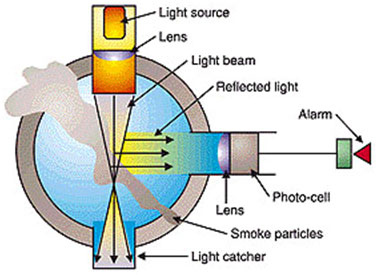
Photoelectric smoke detectors: The basic detection principle of optical detectors is the making or breaking of a circuit in the presence of smoke. Smoke can affect the intensity of light beam passing through the air by obscuring or scattering.
 
A Figure Representing Photoelectric Light Scattering in a Photoelectric Smoke Detector
Fig. 2: A Figure Representing Photoelectric Light Scattering in a Photoelectric Smoke Detector
 
Photoelectric light scattering smoke detector: It has a light beam offset from the photo detector such that in the presence of smoke, some part of the light is scattered onto the light sensor, hence sending off an alarm. Such smoke detectors are usually ‘spot type’ having localized detection area.


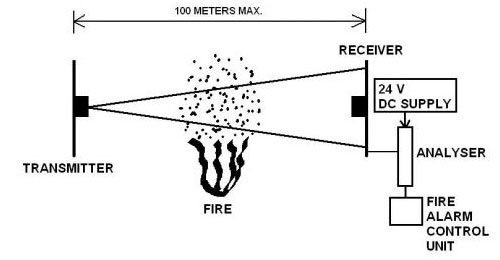
A Figure Demonstrating Photoelectric Light Obscuration Smoke Detector

Fig. 3: A Figure Demonstrating Photoelectric Light Obscuration Smoke Detector

 
Photoelectric light obscuration smoke detector: Another option, less effective though, is to have a line of sight between the light source and a photo detector. When the intensity of light falling on the photo detector falls below a threshold value, alarm is sent off. This design is less effective as a false alarm may be set off in case of obstruction from any physical object. It is usually of ‘projected beam type’ so as to span a wider area.
 
Photoelectric detectors are found to perform better in detecting fires which have a long time of smoldering and release large amounts of smoke. Photoelectric smoke detectors respond quickly to particles between 0.3 and 10.0 microns. However, these are less sensitive to rapidly growing fires when compared to ionization detectors.
 

Ionization Smoke Detectors

Ionization smoke detectors
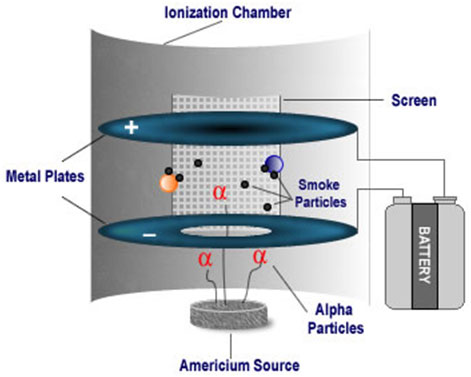
These devices are quick at sensing flaming fires which produce very little smoke. Such devices employ the radioactive properties of some materials to ionize air in a confined area. This is done in a small chamber which consists of two electrodes about a centimeter apart. The housing is made of polyvinylchloride or polystyrene plastic. Typical radiation source is about 0.3 µg of americium – 241 embedded in a gold foil matrix sandwiched between a silver backing and a 2 microns thick palladium laminate. It has a half life of 432 years and decays by emitting alpha rays. The foil is thick enough to retain the radioactive material and still allow the alpha rays to pass through.
 

A Figure Representing an Ionization Smoke Detector
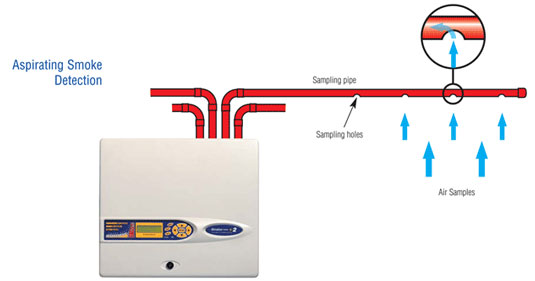
Fig. 4: A Figure Representing an Ionization Smoke Detector


The alpha rays are preferred over beta and gamma rays as they easily ionize air particles, have low penetrative power and can be contained easily. During ionization, electrons are knocked off from oxygen and nitrogen molecules producing charges. These charges are attracted to oppositely charged electrodes and hence form a current in the small chamber. Smoke particles have a size much greater than air molecules. In the presence of smoke, the ionized particles collide and combine with these particles, making these particles act as recombination centers and neutralizing the ions. This reduces the amount of ionized particles in the chamber thereby reducing overall current. The drop in current below a certain threshold triggers an alarm. These detect particles of smoke which are too small to be visible to the naked eye (0.01 and 0.3 microns). Ionization chamber detectors have been available since 1951, but were way too expensive to be used in residences. 

A Diagram Representing Aspirating Smoke Detection

Fig. 5: A Diagram Representing Aspirating Smoke Detection


Air Sampling Smoke Detectors
Air sampling smoke detector: Air sampling smoke detectors are the most technologically advanced of all the three types of detectors. These detectors actively draw in air through a network of small pipes laid out along the ceiling of the protected area working as aspirators. Pipes in the mesh have holes in them from where air samples can be drawn in and passed across a sensitive optical device capable of detecting extremely small particles. Some industrial designs employ filters prior to feeding the air samples to the sensor in order to remove dust and dirt to protect the optical surfaces from contamination. The optical device is usually a high sensitivity laser whose light is scattered through smoke and detected by extremely sensitive sensors in the chamber. These devices are usually used in mission-critical areas like server rooms. Such detectors are capable of having multiple threshold levels for a wide range of smoke level.
 
Obscuration is a unit of measurement used as a standard definition of smoke detector sensitivity and is the effect that smoke has on reducing sensor visibility. Any of these devices would suffer performance setbacks in the presence of steam or high humidity which may lead to condensation on the circuit board and sensors, causing a false alarm. Ionization detectors are generally less expensive than photoelectric detectors but are also prone to false alarms, may go off while cooking too. Settling of dust particles on the radioactive material can make it more sensitive by reducing the amount of radiations and hence reducing the threshold for alarm. To compensate for humidity and atmospheric changes, dual ionization chamber detectors have been developed. In such detectors, one chamber acts as a sensing chamber, open to the outside air and the other is a reference chamber which is affected only by humidity and atmospheric pressure but is insulated from smoke and particulate matter. By using the two chambers, the overall effect of humidity and atmospheric pressure changes can be nullified. It is still ineffective if humidity is too high or there are significant air currents. Ionization detectors have an advantage that a drop in battery voltage is easily detected. With dying batteries, the current drops, and hence an alarm is sounded. In case of photoelectric detectors the light may be reflected from other surfaces and detected by photosensitive device. Electrical transients and radiations can affect the detectors and cause false alarms.
 
It is very difficult to predict the size of smoke produced due to fire due to a variety of combustibles, ignition sources and the effect that an ignition source might have on various combustibles. For example a cigarette may produce slow smoldering fire if dropped on a bed, but produces flaming fire if dropped on a newspaper. A photoelectric detector would be suited in the former case, but would prove to be quite ineffective in the latter. Manufacturers often employ a mixture of detection techniques to improve response times to real fires and also reduce the probability of false detection at the same time. The manufacturers need to conform to the industry standards accepted worldwide.
 

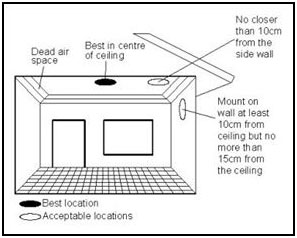
A Representational Image of Acceptable Locations of Air Sampling Smoke Detector

Fig. 6: A Representational Image of Acceptable Locations of air Sampling Smoke Detector


National Fire protection Association (NFPA) publishes standards for the proper application, installation and maintenance of smoke detectors in United States. In United Kingdom the placement of detectors need to comply with British standards BS5839. Smoke alarm provisioning has been ratified by all model building code organizations. NFPA has laid down several guidelines on the use of smoke detectors including directions on installation, placement and reliability. Smoke detectors should be placed on every level of the building and should be connected to the household electrical system. It recommends the replacement of smoke alarm batteries each year and the replacement of the device itself every 10 years. Regular cleaning can help prevent some false alarms.
 
In the 60’s, an average US citizen had not even heard of smoke detectors. Today, about 96% of homes in United States and 85% in United Kingdom have smoke detectors installed. However, about 30% of these smoke detectors are dysfunctional because the batteries died out and were never replaced, or were deliberately removed due to the nuisance of false alarms setting off every now and then. People consider installing smoke detectors as a necessary evil as many agencies in countries like US would not provide mortgage funding for homes which do not have smoke alarms. The effect has been such that more than 65% of the household fire cases are from those homes which do not have these detectors installed, or not operational.
 
Often the detectors need modification to cater to special populations like children from varying age groups, old age people and disabled population, illiterate people etc.. Research is going on to improve the effectiveness of these alarms. Focus areas include waking effectiveness of special populations, quicker response to range of fire types and reduced nuisance alarms, spreading awareness on how to use alarms effectively. The impact of Smoke Detectors has been such that it has been voted into the ‘100 of the Greatest and Influential Gadgets’ inthe Time Magazine. Dreams are important, and as someone has rightly put, “Don’t let your dreams go up in smoke – practice fire safety”. 

Filed Under: Articles
Tagged With: air sampling smoke detector, ionization smoke detector, photoelectric smoke sensor, sensor, smoke detector
 

Next Article

← Previous Article
Next Article →

Questions related to this article?
👉Ask and discuss on EDAboard.com and Electro-Tech-Online.com forums.


Tell Us What You Think!! Cancel reply

You must be logged in to post a comment.

Submit a Guest Post

submit a guest post

EE TECH TOOLBOX

“ee
Tech Toolbox: Power Efficiency
Discover proven strategies for power conversion, wide bandgap devices, and motor control — balancing performance, cost, and sustainability across industrial, automotive, and IoT systems.

EE Learning Center

EE Learning Center
“engineers
EXPAND YOUR KNOWLEDGE AND STAY CONNECTED
Get the latest info on technologies, tools and strategies for EE professionals.

HAVE A QUESTION?

Have a technical question about an article or other engineering questions? Check out our engineering forums EDABoard.com and Electro-Tech-Online.com where you can get those questions asked and answered by your peers!


RSS EDABOARD.com Discussions.

  • Synchronous rectifier chips nil stocked everywhere?
  • Cloning a HDD
  • PDKs setup for Virtuoso
  • improving in delivering a signal from source to load
  • delete my account

RSS Electro-Tech-Online.com Discussions

  • JLCPBC are using a different shipping company = less $$$$$$$$
  • Help please! BLDC driver circuit using the IR2136s and the STP80NF06 MOSFETS
  • need two ICs
  • MLT-8530 Buzzer on ESP32: Why Is the Sound Output Lower Than Expected?
  • Scope Clock CRT Z-Axis - Grid bias positive?

Featured – Real Time Hardware Filter Design

  • Practical implementation of bandpass and band reject filters
  • Practical application of hardware filters with real-life examples
  • A filter design example
  • Types of filter responses
  • What are the two types of hardware filters?
  • What are hardware filters and their types?

Recent Articles

  • GigaDevices introduces 32-bit MCUs with integrated DSP and FPU support
  • Grinn introduces 8-core SBC supporting AI-ready embedded development
  • EPC’s 100 kHz BLDC inverter supports high-efficiency motion control
  • Melexis announces 5 W smart driver to supports sensorless FOC operation
  • STMicroelectronics’ motion sensor simplifies industrial IoT system design

EE ENGINEERING TRAINING DAYS

engineering
Engineers Garage
  • Analog IC TIps
  • Connector Tips
  • Battery Power Tips
  • EDABoard Forums
  • EE World Online
  • Electro-Tech-Online Forums
  • EV Engineering
  • Microcontroller Tips
  • Power Electronic Tips
  • Sensor Tips
  • Test and Measurement Tips
  • 5G Technology World
  • Subscribe to our newsletter
  • About Us
  • Contact Us
  • Advertise

Copyright © 2025 WTWH Media LLC. All Rights Reserved. The material on this site may not be reproduced, distributed, transmitted, cached or otherwise used, except with the prior written permission of WTWH Media
Privacy Policy

Search Engineers Garage

  • Electronic Projects & Tutorials
    • Electronic Projects
      • Arduino Projects
      • AVR
      • Raspberry pi
      • ESP8266
      • BeagleBone
      • 8051 Microcontroller
      • ARM
      • PIC Microcontroller
      • STM32
    • Tutorials
      • Sensor Series
      • 3D Printing
      • AI
      • ARDUINO Compatible Coding
      • Audio Electronics
      • Battery Management
      • Beginners Electronics Series
      • Brainwave
      • Digital electronics (DE)
      • Electric Vehicles
      • EMI/EMC/RFI
      • EVs
      • Hardware Filters
      • IoT tutorials
      • LoRa/LoRaWAN
      • Power Tutorials
      • Protocol
      • Python
      • RPI Python Programming
      • Sensors
      • USB
      • Thermal management
      • Verilog
      • VHDL
    • Circuit Design
    • Project Videos
    • Components
  • Articles
    • Tech Articles
    • Insight
    • Invention Stories
    • How to
    • What Is
  • News
    • Electronic Product News
    • Business News
    • Company/Start-up News
    • DIY Reviews
    • Guest Post
  • Forums
    • EDABoard.com
    • Electro-Tech-Online
    • EG Forum Archive
  • DigiKey Store
    • Cables, Wires
    • Connectors, Interconnect
    • Discrete
    • Electromechanical
    • Embedded Computers
    • Enclosures, Hardware, Office
    • Integrated Circuits (ICs)
    • Isolators
    • LED/Optoelectronics
    • Passive
    • Power, Circuit Protection
    • Programmers
    • RF, Wireless
    • Semiconductors
    • Sensors, Transducers
    • Test Products
    • Tools
  • Learn
    • eBooks/Tech Tips
    • Design Guides
    • Learning Center
    • Tech Toolboxes
    • Webinars & Digital Events
  • Resources
    • Digital Issues
    • EE Training Days
    • LEAP Awards
    • Podcasts
    • Webinars / Digital Events
    • White Papers
    • Engineering Diversity & Inclusion
  • Guest Post Guidelines
  • Advertise
  • Subscribe