Engineers Garage

  • Electronic Projects & Tutorials
    • Electronic Projects
      • Arduino Projects
      • AVR
      • Raspberry pi
      • ESP8266
      • BeagleBone
      • 8051 Microcontroller
      • ARM
      • PIC Microcontroller
      • STM32
    • Tutorials
      • Sensor Series
      • Engineering Deep Dives
      • AI
      • ARDUINO Compatible Coding
      • Audio Electronics
      • Battery Management
      • Beginners Electronics Series
      • Brainwave
      • Digital electronics (DE)
      • Electric Vehicles
      • EMI/EMC/RFI
      • EVs
      • Hardware Filters
      • IoT tutorials
      • LoRa/LoRaWAN
      • Power Tutorials
      • Protocol
      • Python
      • RPI Python Programming
      • Sensors
      • USB
      • Thermal management
      • Verilog
      • VHDL
    • Circuit Design
    • Project Videos
    • Components
  • Articles
    • Tech Articles
    • Insight
    • Invention Stories
    • How to
    • What Is
  • News
    • Electronic Product News
    • Business News
    • Company/Start-up News
    • DIY Reviews
    • Guest Post
  • Forums
    • EDABoard.com
    • Electro-Tech-Online
    • EG Forum Archive
  • DigiKey Store
    • Cables, Wires
    • Connectors, Interconnect
    • Discrete
    • Electromechanical
    • Embedded Computers
    • Enclosures, Hardware, Office
    • Integrated Circuits (ICs)
    • Isolators
    • LED/Optoelectronics
    • Passive
    • Power, Circuit Protection
    • Programmers
    • RF, Wireless
    • Semiconductors
    • Sensors, Transducers
    • Test Products
    • Tools
  • Learn
    • eBooks/Tech Tips
    • Design Guides
    • Learning Center
    • Tech Toolboxes
    • Webinars & Digital Events
  • Resources
    • Digital Issues
    • EE Training Days
    • LEAP Awards
    • Podcasts
    • Webinars / Digital Events
    • White Papers
    • Engineering Diversity & Inclusion
  • Guest Post Guidelines
  • Advertise
  • Subscribe

Difference Between GSM and CDMA

By Ashutosh Bhatt February 1, 2012

GSM (Global System for Mobile Communication) and CDMA (Code Division Multiple Access) are two dominant technologies for mobile communication. These two technologies differ in the way calls and data travel over the mobile phone networks take place. On comparing both the technologies GSM has some limitation when the call quality is concerned but still has more flexibility and an easy implementation relative to the CDMA technology. The major difference between the two lies in terms of the technology they use, security factors, their global reach and the data transfer speeds.
1.      Technology

The CDMA is based on spread spectrum technology which makes the optimal use of available bandwidth. It allows each user to transmit over the entire frequency spectrum all the time. On the other hand GSM operates on the wedge spectrum called a carrier. This carrier is divided into a number of time slots and each user is assigned a different time slot so that until the ongoing call is finished, no other subscriber can have access to this. GSM uses both Time Division Multiple Access (TDMA) and Frequency Division Multiple Access (FDMA) for user and cell separation. TDMA provides multiuser access by chopping up the channel into different time slices and FDMA provides multiuser access by separating the used frequencies.

2.      Security

More security is provided in CDMA technology as compared with the GSM technology as encryption is inbuilt in the CDMA. A unique code is provided to every user and all the conversation between two users are encoded ensuring a greater level of security for CDMA users. The signal cannot be detected easily in CDMA as compared to the signals of GSM, which are concentrated in the narrow bandwidth. Therefore, the CDMA phone calls are more secure than the GSM calls. In terms of encryption the GSM technology has to be upgraded so as to make it operate more securely.

3.      Spectrum Frequencies

The CDMA network operates in the frequency spectrum of CDMA 850 MHz and 1900 MHz while the GSM network operates in the frequency spectrum of GSM 850 MHz and 1900 MHz.

4.      Global Reach

GSM is in use over 80% of the world’s mobile networks in over 210 countries as compared to CDMA. CDMA is almost exclusively used in United States and some parts of Canada and Japan. As the European Union permissions GSM use, so CDMA is not supported in Europe. In North America, especially in rural areas, more coverage is offered by CDMA as compared to GSM. As GSM is an international standard, so it’s better to use GSM in international roaming. GSM is in use by 76% of users as compared to CDMA which is in use by 24% users.
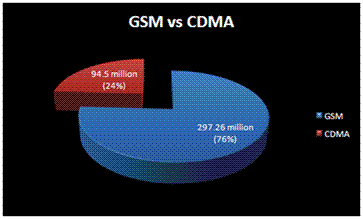
 

GSM vs CDMA

5.      Data Transfer Rate

CDMA has faster data rate as compared to GSM as EVDO data transfer technology is used in CDMA which offers a maximum download speed of 2 mbps.  EVDO ready mobile phones are required to use this technology. GSM uses EDGE data transfer technology that has a maximum download speed of 384 kbps which is slower as compared to CDMA. For browsing the web, to watch videos and to download music, CDMA is better choice as compared to GSM. So CDMA is known to cover more area with fewer towers.

6.      Radiation Exposure

GSM phones emit continuous wave pulses, so there is a large need to reduce the exposures to electromagnetic fields focused on cell phones with “continuous wave pulses”. On the other hand CDMA cell phones do not produce these pulses. GSM phones emit about 28 times more radiation on average as compared to CDMA phones. Moreover, GSM phones are more biologically reactive as compared to CDMA.


  •  


Filed Under: How to
Tagged With: cdma, gsm
 

Next Article

← Previous Article
Next Article →

Questions related to this article?
👉Ask and discuss on Electro-Tech-Online.com and EDAboard.com forums.


Tell Us What You Think!! Cancel reply

Log in to leave a comment:

Lost your password?

Don't have an account? Register here

Submit a Guest Post

submit a guest post

EE TECH TOOLBOX

“ee
Tech Toolbox: Sensors
In this Tech Toolbox, we cover some of those technologies driving the next generation of connected systems, including ultra-low-power sensing strategies that extend node battery life, and 60 GHz CMOS radar for contactless health and presence detection.

EE Learning Center

EE Learning Center
“engineers
EXPAND YOUR KNOWLEDGE AND STAY CONNECTED
Get the latest info on technologies, tools and strategies for EE professionals.

HAVE A QUESTION?

Have a technical question about an article or other engineering questions? Check out our engineering forums EDABoard.com and Electro-Tech-Online.com where you can get those questions asked and answered by your peers!


RSS EDABOARD.com Discussions.

  • Does Machine Constant in Torque Equation for Repulsion Motor Depends on Supply Frequency like Proportionality constant in induction motor?
  • Non-synchronized SMPS's are fine?
  • What is the best way to do 10Mhz to 50Mhz generation?
  • Is it possible for a sequential cell’s D pin to have both setup_rising and hold_falling timing arcs in a Liberty file?
  • SonnetSuite simulation excitation ports

RSS Electro-Tech-Online.com Discussions

  • washing machine motor wiring
  • effect of calibration on s-parameters
  • Mitsubishi Electric IPM module lot code format - how to decode?
  • Replacement IGBT for DGG4015 for Honda Motorcycle ECU
  • TDK Lambda ESS 500-20-11-D-LB-RSTL Parallel Operation

Featured Tutorials

Learn - VHDL Tutorials (22 Part)

  • VHDL Tutorial – 11: Designing half and full-subtractor circuits
    VHDL Tutorial – 11: Designing half and full-subtractor circuits
  • VHDL Tutorial – 12: Design a 8-bit parity generator and circuit checker
    VHDL Tutorial – 12: Design a 8-bit parity generator and circuit checker
  • VHDL tutorial 13: Design 3×8 decoder and 8×3 encoder using VHDL
    VHDL tutorial 13: Design 3×8 decoder and 8×3 encoder using VHDL
  • VHDL Tutorial 14: Design 1×8  demultiplexer and 8×1 multiplexer using VHDL
    VHDL Tutorial 14: Design 1×8  demultiplexer and 8×1 multiplexer using VHDL
  • VHDL Tutorial 17: Design a JK flip-flop (with preset and clear) using VHDL
    VHDL Tutorial 17: Design a JK flip-flop (with preset and clear) using VHDL
  • VHDL Tutorial 18: Design a T flip-flop (with enable and an active high reset input) using VHDL
    VHDL Tutorial 18: Design a T flip-flop (with enable and an active high reset input) using VHDL
More Tutorials >

Recent Articles

  • Menlo Micro launches DC to 70 GHz RF switch
  • GigaDevice targets optical modules with new MCUs
  • HMS Networks bridges Automotive Ethernet and standard Ethernet
  • Nuvoton adds post-quantum security to secure MCU
  • TI battery monitor delivers less than 2 mV accuracy

EE ENGINEERING TRAINING DAYS

engineering
Engineers Garage
  • Analog IC TIps
  • Connector Tips
  • Battery Power Tips
  • EDABoard Forums
  • EE World Online
  • Electro-Tech-Online Forums
  • EV Engineering
  • Microcontroller Tips
  • Power Electronic Tips
  • Sensor Tips
  • Test and Measurement Tips
  • 5G Technology World
  • Subscribe to our newsletter
  • About Us
  • Contact Us
  • Advertise

Copyright © 2026 WTWH Media LLC. All Rights Reserved. The material on this site may not be reproduced, distributed, transmitted, cached or otherwise used, except with the prior written permission of WTWH Media
Privacy Policy

Search Engineers Garage

  • Electronic Projects & Tutorials
    • Electronic Projects
      • Arduino Projects
      • AVR
      • Raspberry pi
      • ESP8266
      • BeagleBone
      • 8051 Microcontroller
      • ARM
      • PIC Microcontroller
      • STM32
    • Tutorials
      • Sensor Series
      • Engineering Deep Dives
      • AI
      • ARDUINO Compatible Coding
      • Audio Electronics
      • Battery Management
      • Beginners Electronics Series
      • Brainwave
      • Digital electronics (DE)
      • Electric Vehicles
      • EMI/EMC/RFI
      • EVs
      • Hardware Filters
      • IoT tutorials
      • LoRa/LoRaWAN
      • Power Tutorials
      • Protocol
      • Python
      • RPI Python Programming
      • Sensors
      • USB
      • Thermal management
      • Verilog
      • VHDL
    • Circuit Design
    • Project Videos
    • Components
  • Articles
    • Tech Articles
    • Insight
    • Invention Stories
    • How to
    • What Is
  • News
    • Electronic Product News
    • Business News
    • Company/Start-up News
    • DIY Reviews
    • Guest Post
  • Forums
    • EDABoard.com
    • Electro-Tech-Online
    • EG Forum Archive
  • DigiKey Store
    • Cables, Wires
    • Connectors, Interconnect
    • Discrete
    • Electromechanical
    • Embedded Computers
    • Enclosures, Hardware, Office
    • Integrated Circuits (ICs)
    • Isolators
    • LED/Optoelectronics
    • Passive
    • Power, Circuit Protection
    • Programmers
    • RF, Wireless
    • Semiconductors
    • Sensors, Transducers
    • Test Products
    • Tools
  • Learn
    • eBooks/Tech Tips
    • Design Guides
    • Learning Center
    • Tech Toolboxes
    • Webinars & Digital Events
  • Resources
    • Digital Issues
    • EE Training Days
    • LEAP Awards
    • Podcasts
    • Webinars / Digital Events
    • White Papers
    • Engineering Diversity & Inclusion
  • Guest Post Guidelines
  • Advertise
  • Subscribe