Engineers Garage

  • Electronic Projects & Tutorials
    • Electronic Projects
      • Arduino Projects
      • AVR
      • Raspberry pi
      • ESP8266
      • BeagleBone
      • 8051 Microcontroller
      • ARM
      • PIC Microcontroller
      • STM32
    • Tutorials
      • Complete Sensor Guide
      • Engineering Deep Dives
      • AI
      • ARDUINO Compatible Coding
      • Audio Electronics
      • Battery Management
      • Beginners Electronics Series
      • Brainwave
      • Digital electronics (DE)
      • Electric Vehicles
      • EMI/EMC/RFI
      • EVs
      • Hardware Filters
      • IoT tutorials
      • LoRa/LoRaWAN
      • Power Tutorials
      • Protocol
      • Python
      • RPI Python Programming
      • Sensors
      • USB
      • Thermal management
      • Verilog
      • VHDL
    • Circuit Design
    • Project Videos
    • Components
  • Articles
    • Tech Articles
    • Insight
    • Invention Stories
    • How to
    • What Is
  • News
    • Electronic Product News
    • Business News
    • Company/Start-up News
    • DIY Reviews
    • Guest Post
  • Forums
    • EDABoard.com
    • Electro-Tech-Online
    • EG Forum Archive
  • DigiKey Store
    • Cables, Wires
    • Connectors, Interconnect
    • Discrete
    • Electromechanical
    • Embedded Computers
    • Enclosures, Hardware, Office
    • Integrated Circuits (ICs)
    • Isolators
    • LED/Optoelectronics
    • Passive
    • Power, Circuit Protection
    • Programmers
    • RF, Wireless
    • Semiconductors
    • Sensors, Transducers
    • Test Products
    • Tools
  • Learn
    • Design Guides
    • Learning Center
    • Tech Toolboxes
    • Tech Terms
    • Webinars & Digital Events
  • Resources
    • EE Training Days
    • LEAP Awards
    • Podcasts
    • White Papers
  • Guest Post Guidelines
  • Advertise
  • Subscribe

Electronic Circuit Designing: Result and Analysis (Part 6)

By Ashutosh Bhatt August 17, 2021

The switch ‘SW’ is connected for testing in such a way that it can close and open the contact with the ground and PIN C of the BOARD_A. The PIN B should be connected with the PIN D so that the INDICATOR module can get positive voltage.

Suppose when the power is applied and the SW is open, the INDICATOR module should have the red LED glowing only and we can find the video and sound from the DTH set top box on the TV. When I toggle the switch I can hear the clicking sound from the RELAY module and the yellow LED in the INDICATOR modules glows only. Now the sound and video from the DVD- player on the TV is found.

If the BOARD_A initiates we can say that it is working perfectly as we have expected.

Now let us build the BOARD_B and test it with the BOARD_A. The BOARD_B should have the connectors for IR_RECEIVER, COMPARATOR, MONOSTABLE and REGULATOR modules. It should also include circuits for relay driving and IR indication. We have built the BOARD_B which has all the mentioned things and the image of the same is shown below.
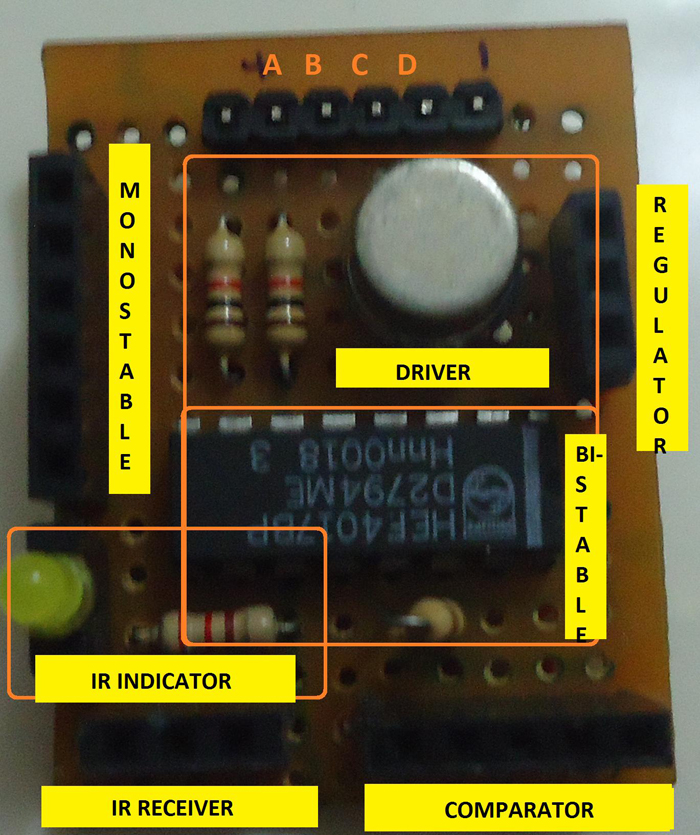
Top Plane View Of BOARD_B

Fig. 1: Top Plane View of BOARD_B

Now we can plug in the modules to their corresponding female connectors in the BOARD_B. The fully assembled BOARD_B with all the modules is shown in the following image.
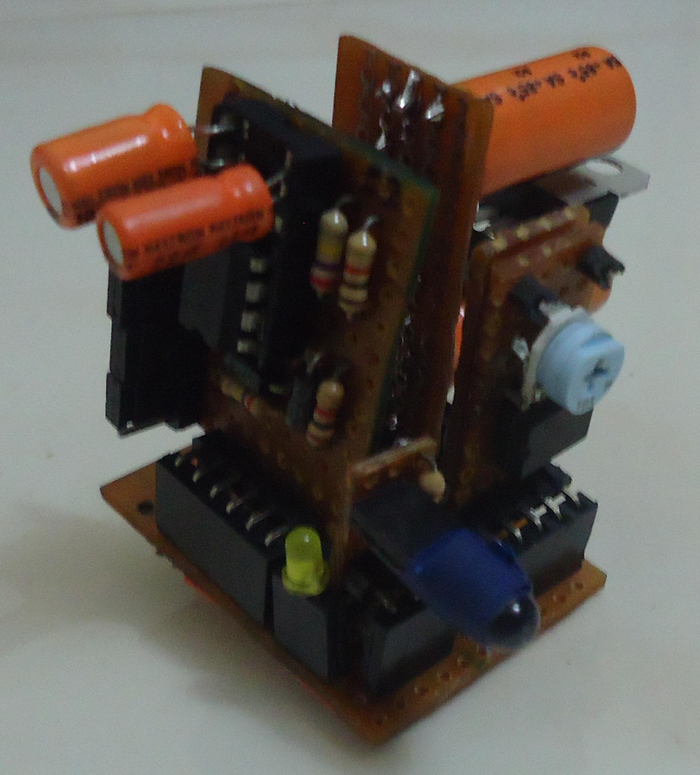
 Fully Assembled BOARD_B With Connected Modules

Fig.2: Fully Assembled BOARD_B with Connected Modules

Connecting Boards and Conclusion

The assembly process is said to be finished when we connect the BOARD_B to the BOARD_A. The image of the BOARD_B connected to the BOARD_A is which forms our complete prototype is shown in the following figure.
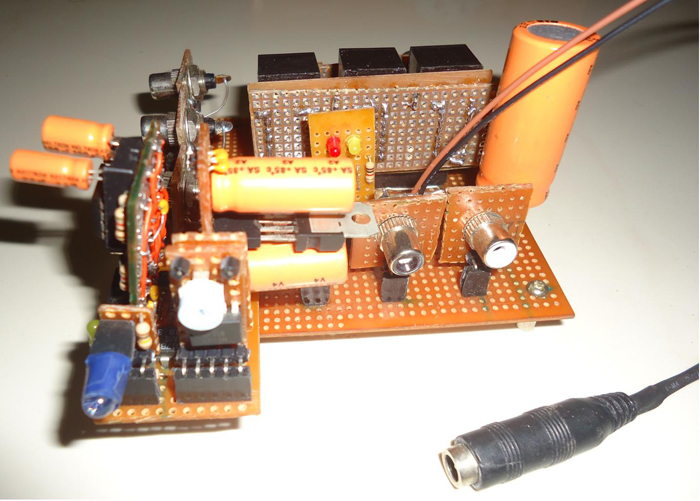
Prototype Of BOARD_B Connected To The BOARD_A

Fig.3: Prototype Of BOARD_B Connected To The BOARD_A

Now we can connect the audio-video connectors from TV, DVD player and DTH set top box. The device is initiated using a 9V, 5 A power supply and the TV or DVD remote control to operate the device.

Conclusion:

We have successfully explained the Electronic Modular Design and Assembly technique using a sample project. We also developed the prototype of the device through the ten steps of the Electronic Modular Design and Assembly method. In the course of explaining the method we have given special care to go in depth of the working details of the project. Most of the people hate timing diagram just because they don’t know how to read them. Actually a timing diagram contains all the details of the working of a device and hence we have given special care to explain timing diagrams in detail.

We started off with a simple idea, then we analyzed the requirement, we have developed the block diagram, then we have designed the complete circuit diagram, we have assumed the reusable modules from the circuit diagram, we build them individually, tested them and assembled them together to form our prototype. The important part is that we had to design only the very basic and well known circuits each and every time and using this method we were able to integrate them into a complex circuit. Thus anyone who is familiar with the basic electronic circuits can design complex circuits and prototype them quickly using the method of Electronic Modular Design and Assembly. 

Videos

Videos


Filed Under: Circuit Design


Next Article

← Previous Article
Next Article →

Questions related to this article?
👉Ask and discuss on Electro-Tech-Online.com and EDAboard.com forums.


Tell Us What You Think!! Cancel reply

Log in to leave a comment:

Lost your password?

Don't have an account? Register here

Submit a Guest Post

submit a guest post

EE TECH TOOLBOX

“ee
Tech Toolbox: Wide Bandgap Semiconductors
Moving from silicon to GaN or SiC feels like a whole new ballgame, doesn’t it? It isn’t just about faster switching; it’s about managing the layout parasitics and thermal realities that come with that speed. This month’s Tech Toolbox features a curated eBook that tackles these design hurdles head-on.

EE Learning Center

EE Learning Center
“engineers
EXPAND YOUR KNOWLEDGE AND STAY CONNECTED
Get the latest info on technologies, tools and strategies for EE professionals.

HAVE A QUESTION?

Have a technical question about an article or other engineering questions? Check out our engineering forums EDABoard.com and Electro-Tech-Online.com where you can get those questions asked and answered by your peers!


RSS feed: EDABOARD.com Discussions. EDABOARD.com Discussions.

  • lm393 comparator
  • Need Help to design an array antenna
  • What is the Q-factor of an NFC antenna?
  • How to design a schematic to look professional
  • Op-Amp signal conversion circuit

RSS feed: Electro-Tech-Online.com Discussions Electro-Tech-Online.com Discussions

  • JAB Electronic Components
  • DBT alternative idea
  • Schematic help, odd symbol
  • RC circuit voltage and current
  • How much does generator frequency stability matter for sensitive electrical equipment?

Featured Tutorials

VHDL Series (1-24)

  • VHDL Tutorial 17: Design a JK flip-flop (with preset and clear) using VHDL
    VHDL Tutorial 17: Design a JK flip-flop (with preset and clear) using VHDL
  • VHDL Tutorial 18: Design a T flip-flop (with enable and an active high reset input) using VHDL
    VHDL Tutorial 18: Design a T flip-flop (with enable and an active high reset input) using VHDL
  • VHDL Tutorial – 19: Designing a 4-bit binary counter using VHDL
    VHDL Tutorial – 19: Designing a 4-bit binary counter using VHDL
  • VHDL Tutorial – 20: Designing 4-bit binary-to-gray & gray-to-binary code converters
    VHDL Tutorial – 20: Designing 4-bit binary-to-gray & gray-to-binary code converters
  • VHDL Tutorial – 21: Designing an 8-bit, full-adder circuit using VHDL
    VHDL Tutorial – 21: Designing an 8-bit, full-adder circuit using VHDL
  • VHDL Tutorial – 22: Designing a 1-bit & an 8-bit comparator by using VHDL
    VHDL Tutorial – 22: Designing a 1-bit & an 8-bit comparator by using VHDL
More Tutorials >

Recent Articles

  • Teradyne optical tester measures millions of microLED emitters
  • Molex 16-fiber EBO connector delivers 3× density in 1RU
  • Harwin introduces online connector selector
  • Elma releases VNX+ deployment kit for embedded systems
  • Lattice introduces AI-assisted FPGA development tool

EE ENGINEERING TRAINING DAYS

engineering
Engineers Garage
  • Analog IC TIps
  • Connector Tips
  • Battery Power Tips
  • EDABoard Forums
  • EE World Online
  • Electro-Tech-Online Forums
  • EV Engineering
  • Microcontroller Tips
  • Power Electronic Tips
  • Sensor Tips
  • Test and Measurement Tips
  • 5G Technology World
  • Subscribe to our newsletter
  • About Us
  • Contact Us
  • Advertise

Copyright © 2026 Arrowfly LLC. All Rights Reserved. The material on this site may not be reproduced, distributed, transmitted, cached or otherwise used, except with the prior written permission of Arrowfly
Privacy Policy

Search Engineers Garage

  • Electronic Projects & Tutorials
    • Electronic Projects
      • Arduino Projects
      • AVR
      • Raspberry pi
      • ESP8266
      • BeagleBone
      • 8051 Microcontroller
      • ARM
      • PIC Microcontroller
      • STM32
    • Tutorials
      • Complete Sensor Guide
      • Engineering Deep Dives
      • AI
      • ARDUINO Compatible Coding
      • Audio Electronics
      • Battery Management
      • Beginners Electronics Series
      • Brainwave
      • Digital electronics (DE)
      • Electric Vehicles
      • EMI/EMC/RFI
      • EVs
      • Hardware Filters
      • IoT tutorials
      • LoRa/LoRaWAN
      • Power Tutorials
      • Protocol
      • Python
      • RPI Python Programming
      • Sensors
      • USB
      • Thermal management
      • Verilog
      • VHDL
    • Circuit Design
    • Project Videos
    • Components
  • Articles
    • Tech Articles
    • Insight
    • Invention Stories
    • How to
    • What Is
  • News
    • Electronic Product News
    • Business News
    • Company/Start-up News
    • DIY Reviews
    • Guest Post
  • Forums
    • EDABoard.com
    • Electro-Tech-Online
    • EG Forum Archive
  • DigiKey Store
    • Cables, Wires
    • Connectors, Interconnect
    • Discrete
    • Electromechanical
    • Embedded Computers
    • Enclosures, Hardware, Office
    • Integrated Circuits (ICs)
    • Isolators
    • LED/Optoelectronics
    • Passive
    • Power, Circuit Protection
    • Programmers
    • RF, Wireless
    • Semiconductors
    • Sensors, Transducers
    • Test Products
    • Tools
  • Learn
    • Design Guides
    • Learning Center
    • Tech Toolboxes
    • Tech Terms
    • Webinars & Digital Events
  • Resources
    • EE Training Days
    • LEAP Awards
    • Podcasts
    • White Papers
  • Guest Post Guidelines
  • Advertise
  • Subscribe