To understand the modern electric vehicle (EV), it helps to look beyond the touchscreen dashboard, the battery skateboard, and the software updates delivered over the air. Deep inside the powertrain is a component that has changed relatively little in concept since the late 20th century: the permanent magnet synchronous motor (PMSM).
Many EVs, whether family hatchbacks or performance sedans, use strong permanent magnets fixed inside a rotating rotor. Those magnets are made from critical rare-earth elements, primarily neodymium (Nd), dysprosium (Dy), and praseodymium (Pr). They help give the motor its high power density, rapid acceleration, and efficiency within a compact, lightweight package.
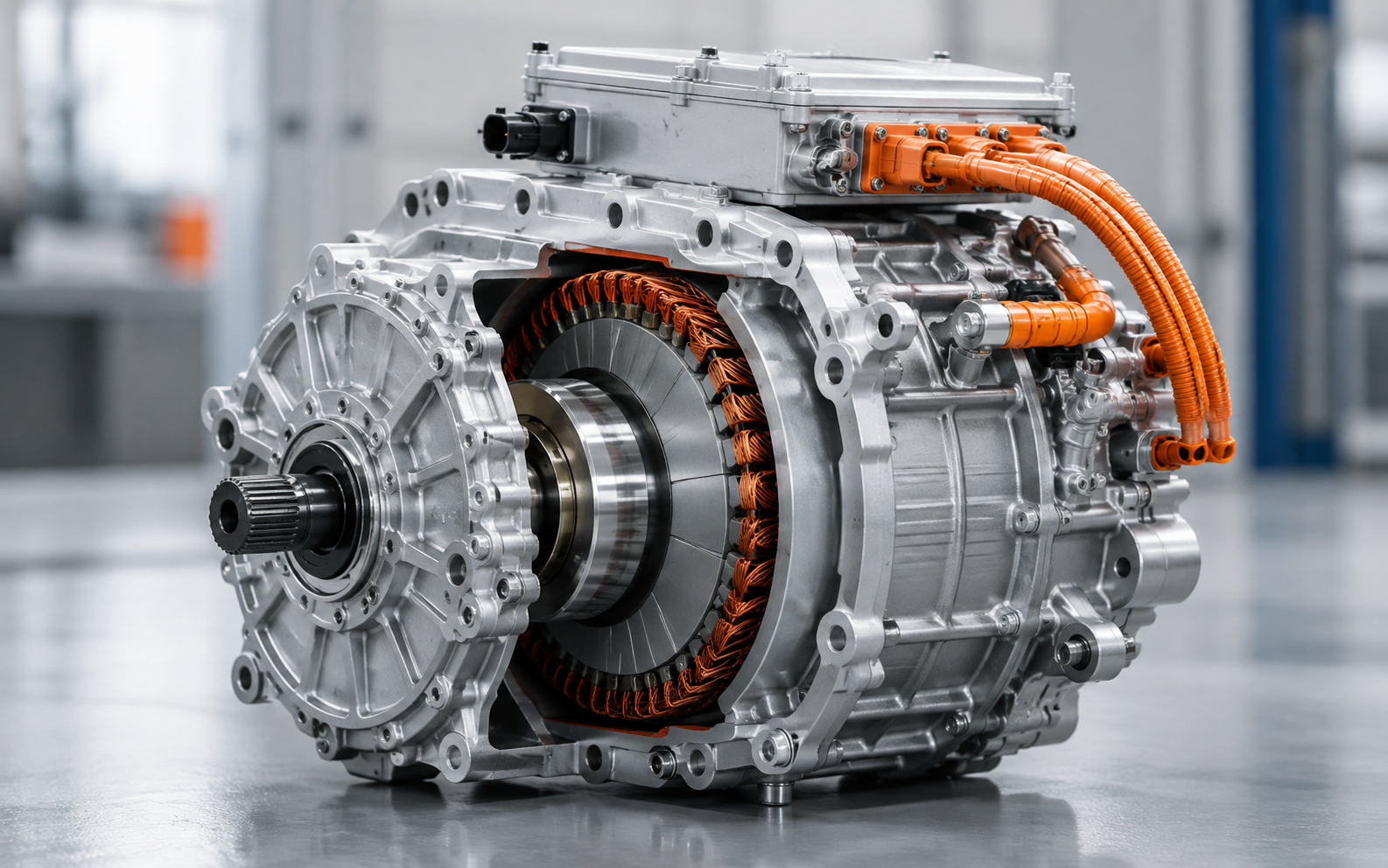
A cutaway view of an electric vehicle traction motor showing the rotor, stator, and copper windings.
They’re also a significant supply-chain and geopolitical vulnerability. China dominates rare-earth refining and the production of finished neodymium-iron-boron (NdFeB) magnets used in high-power motors. A disruption at either stage could affect EV production worldwide.
In Bengaluru, India’s deep-tech hub, startups including Vimag Labs, which sells under the Volektra brand, and Chara Technologies are developing rare-earth-free electric motors. Magnet-free motors already exist, and automakers including BMW and Tesla use them. What hasn’t yet been achieved at scale is a rare-earth-free motor that matches the torque, size, efficiency, and cost of a comparable permanent magnet motor.
There’s no permanent magnet in Vimag’s rotor. Instead, the magnetic field normally supplied by a magnet is generated on demand by copper windings, powered through a contactless coupling, and adjusted in real time by control software. A motor that relies on copper, steel, and conventional power electronics could, in principle, be manufactured end to end in India. The goal is to reduce dependence on China’s rare-earth supply chain while addressing a significant industry challenge.
The underlying engineering is more nuanced than the headline suggests. The motor topology Vimag is using isn’t new. What the company claims as its own is a specific method of transferring power into a rotating rotor without brushes, along with the control system that manages it.
Part 1 of the article examines the motor architecture, why companies are pursuing this approach, and the engineering challenges involved in replacing permanent magnets. Part 2 will look at how Vimag’s excitation and control systems work, where the technology may be most practical, and which performance claims still require independent validation.
You may also like:



Filed Under: EV Engineering, Tech Articles
Log in to leave a comment:
Lost your password?
Don't have an account? Register here