TME has expanded its offering with Raytac Bluetooth Low Energy (BLE) modules based on Nordic Semiconductor SoCs with Arm Cortex-M4F or Cortex-M33 cores, 192 kB to 1.5 MB of program memory and up to 256 kB of RAM. The modules support BLE versions 4.0 to 6.2 with data rates up to 2 Mb/s, Long Range…
GigaDevice launches I²C EEPROM with integrated ECC

The GD24CL series from GigaDevice is an I²C EEPROM family for long-term storage of configuration and other critical system data in industrial, energy, IoT, data center and networking applications. The devices support 100 kHz, 400 kHz and 1 MHz I²C operation, offer endurance up to 4 million program/erase cycles, data retention up to 100 years,…
How to enable device-to-device messaging on AWS IoT Core using MQTT
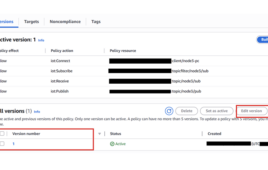
In the previous tutorials, we learned how to create setups for various devices, such as ESP32, Raspberry Pi, and computers on AWS IoT Core, create and attach AWS IoT policies, and communicate data in the form of MQTT messages between Internet-of-Things (IoT) devices and the AWS IoT platform. In IoT applications, devices must exchange data…
How to connect Raspberry Pi to Amazon AWS IoT Core using MQTT
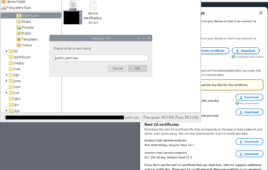
In the previous tutorial, we learned how to connect ESP32 to AWS IoT Core and exchanged messages using the MQTT broker. In this project, we’ll apply the same approach using Raspberry Pi. Raspberry Pi is configured to connect to AWS IoT Core, publish messages to the cloud over MQTT, and receive messages from the cloud…
How to connect ESP32 to AWS IoT Core using MQTT
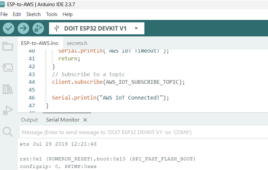
In the previous tutorial, we learned how to create an AWS account and explored some of the services provided by this cloud platform. Now we’ll move on to the implementation. In this project, we’ll create a Thing in AWS IoT Core, configure an ESP32 for that Thing, and connect the ESP32 to AWS IoT Core…
How to connect a computer to AWS IoT Core

In the previous tutorial, we connected a Raspberry Pi to AWS IoT Core and exchanged data between the cloud platform and the Raspberry Pi using MQTT. In many embedded applications, Internet-of-Things (IoT) devices are controlled or monitored through a desktop application. For that reason, it’s often useful to configure a computer (whether it’s a Windows…
What is AWS IoT Core and when should you use it?

In the previous tutorial, we discussed Internet of Things (IoT) platforms. As IoT solutions scale in size and complexity, these tools become essential for managing devices, data, and overall system performance. However, not all platforms serve the same function. Generally speaking, they fall into categories such as device management, connectivity management, application enablement, cloud integration,…
Getting started with AWS IoT Core

Amazon Web Services (AWS) is Amazon’s cloud computing platform that provides on-demand IT services like servers, storage, databases, and networking over the internet on a pay-as-you-go basis. Instead of buying server hardware, it allows you to rent computing resources to deploy applications, store data, and run workloads from Amazon’s data centers worldwide. You only pay…
How to design a JavaScript application for communication with AWS IoT Core

In the previous tutorials, we demonstrated how to communicate data with AWS IoT Core using an ESP32, Raspberry Pi and a computer or laptop. We also covered device-to-device communication through AWS IoT Core using an MQTT broker. In this project, we’ll demonstrate how to communicate with AWS IoT Core using JavaScript. The application developed in this…
Nordic adds AI-assisted workflow for wireless IoT
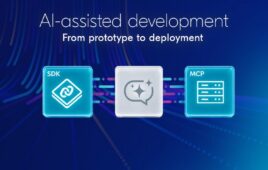
Nordic Semiconductor has introduced AI-assisted development tools for wireless IoT workflows spanning prototyping, software development, production handover and deployed device support. The capability works with Nordic MCP servers and is intended to support tasks such as proof-of-concept development, SDK migration, custom board bring-up, root-cause analysis and device debugging. The tools are designed to work with…
“How do I start and build an electronics project as a beginner?
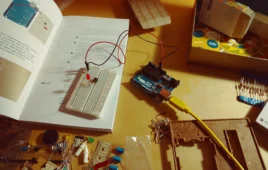
How to Start an Electronics Project (Beginner to Final Year Guide) Step 1: Choose the Right Type of Project (With Direction) Most beginners fail at this exact step. Choosing the right project type is the foundation of your entire build—and where most beginners go wrong. They pick too advanced project like (IoT + AI +…
MediaTek Genio Pro hits 50 TOPS on 3 nm for robotics, drone AI

The Genio Pro, Genio 420 and Genio 360 IoT platforms from MediaTek are edge AI and embedded processors designed for IoT, robotics and machine vision systems. Built on a 3 nm process, Genio Pro integrates Arm Cortex-X925, Cortex-X4 and Cortex-A720 cores with an 8th generation NPU delivering over 50 TOPS, supports up to 16 cameras,…
Wi-SUN Alliance launches FAN 1.1 Low Energy certification
The FAN 1.1 Low Energy Certification from the Wi-SUN Alliance is a standards-based certification program that enables ultra-low-power, battery-operated and energy-harvesting devices to operate within Wi-SUN FAN mesh networks alongside higher-performance endpoints. The certification supports devices designed for long operational life, including battery-powered nodes with 10–20 year lifetimes and solar-powered systems, while maintaining secure communications,…
DHRUV64: India’s first indigenous 1.0 GHz 64-bit dual-core processor

Recently, India crossed another milestone in its semiconductor journey. On December 15th, 2025, the Ministry of Electronics and Information Technology (MeitY) announced the launch of DHRUV64, the country’s first fully indigenous 1.0 GHz, 64-bit dual-core microprocessor. The chip was developed by the Centre for Development of Advanced Computing (C-DAC) under MeitY’s Microprocessor Development Programme (MDP)…
Ultra-efficient NPU from Nordic Semiconductor supports embedded AI tasks

The nRF54LM20B wireless SoC from Nordic Semiconductor integrates an Axon neural processing unit with a 128 MHz Arm Cortex-M33 and a RISC-V coprocessor to support on-device edge AI in battery-powered IoT designs. The device includes 2 MB nonvolatile memory, 512 KB RAM and a low-power 2.4 GHz radio supporting Bluetooth LE, Thread and Matter, targeting…
Understanding IoT application layer protocols

In previous tutorials, we covered various Internet-ofThings (IoT) network topologies, architecture, and technologies — including short-range and long-range IoT technologies. Before delving into cloud-based IoT solution development using Amazon Web Services, it’s important to understand a fundamental IoT concept: the application layer protocols. An application layer protocol is a set of rules that allows software…
IoT-based heart rate monitoring system
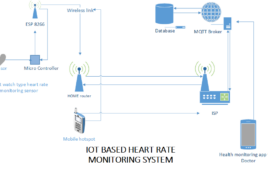
In this project we are going to make heart beat monitor system which will be able to send the readings in bpm to the doctor directly through internet using MQTT protocol from anywhere in the world. The ESP 8266 and Arduino are used to read the reading from sensor and then send them to the…
Understanding long-range wireless IoT technologies

In the previous tutorial, we discussed various short-range wireless Internet-of-Things (IoT) technologies, including Bluetooth, Wi-Fi, Zigbee, Zigbee Mesh, Z-Wave, Thread, NFC, RFID, and IR. These short-range technologies are useful for setting up Personal Area Networks (PANs), Home Area Networks (HANs), and Local Area Networks (LANs). These networks often provide high-bandwidth, high-speed connectivity, allowing smart devices…
The road to ISM 2.0: Building a self-reliant chip ecosystem in India

India stands at a pivotal moment in global technology transformation, striving for self-reliance and leadership in semiconductors. Semiconductor chips are the fundamental components that power modern technologies, from smartphones and cloud infrastructure to artificial intelligence (AI). The India Semiconductor Mission (ISM), launched in 2021, lays the foundation for developing domestic capabilities in semiconductor design, manufacturing,…
Understanding short-range wireless IoT technologies

In the previous tutorial, we discussed different types of Internet of Things (IoT) networks, with a particular focus on M2M networks. We also explored various IoT network topologies. These networks can be categorized based on their coverage area and application. Understanding this categorization is essential for determining effective deployment strategies. When planning the physical setup…