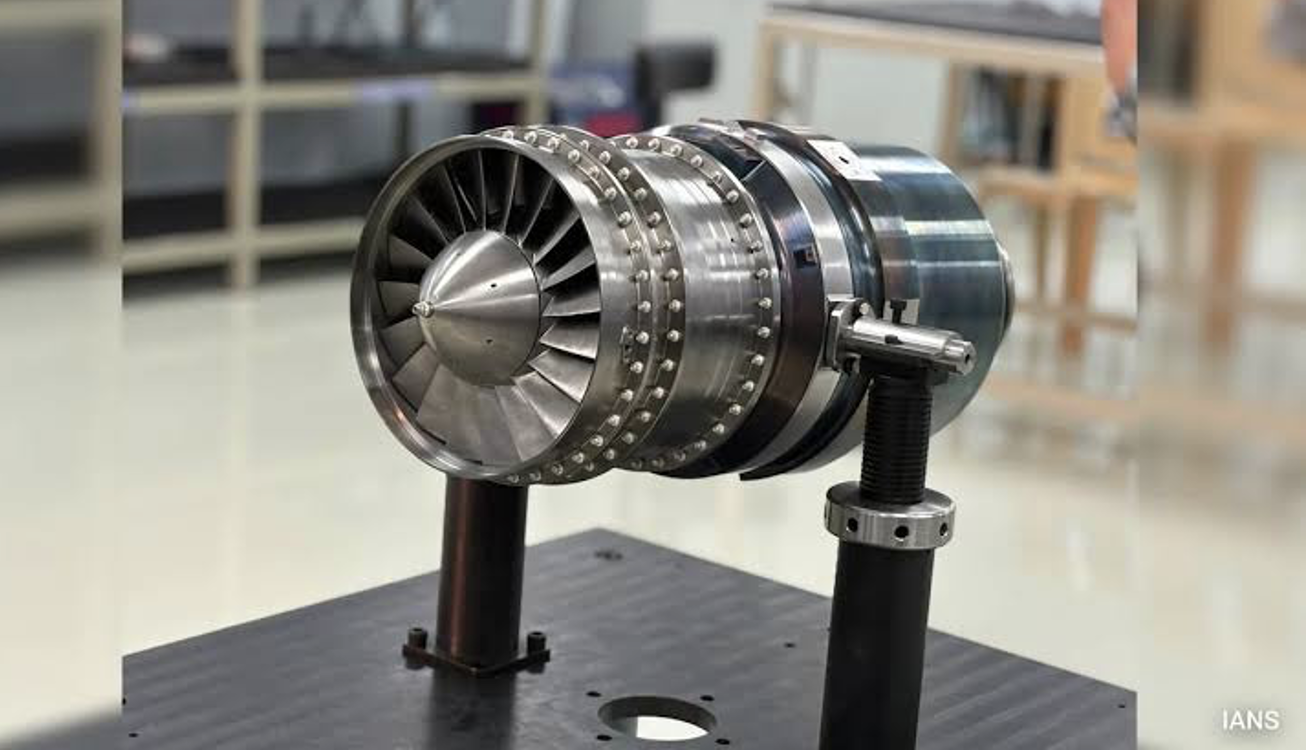
In late July 2026, India crossed an aero-propulsion milestone that got far less mainstream attention than it deserved. On July 22, its first indigenous expendable turbojet engine in the 350 kg thrust class was successfully developed and delivered to the Gas Turbine Research Establishment (GTRE). Designed by GTRE, the engine was manufactured and assembled by Hyderabad-based Azad Engineering. The Ministry of Defence announced the milestone the following day, calling it a landmark achievement for India’s aerospace and defense ecosystem.
The distinction is important. This isn’t India’s first jet engine, and it isn’t going to power a fighter. It’s a small, single-use engine suited to missiles, unmanned aerial vehicles (UAVs), and other expendable platforms. What’s notable is the speed of the program, the manufacturing model behind it, and what it reveals about where India is making progress in aero-propulsion.
This article looks at what the engine is and the history of Indian jet engine development behind it. It also explains why small expendable engines pose a different engineering problem from fighter engines and what can be established about the technology from public information. Finally, it looks at the platforms an engine of this class could support and how the program fits alongside Kaveri and India’s broader push for a homegrown fighter engine.
What was announced?
The public details are limited and worth stating plainly. GTRE designed the engine, while Azad Engineering manufactured and assembled it. The thrust class is 350 kgf, which works out to roughly 3.4 kN. The official announcement identifies the engine as expendable, and that classification carries much of the engineering significance. Azad Engineering reportedly realized and delivered the engine in around 24 months, which is a short timeline by aero-engine standards.
The handover is an important manufacturing and integration milestone, but it isn’t the same as flight qualification on a specific weapon. It also doesn’t mean the engine has been cleared for series production or induction. The Ministry of Defence release provides few technical details beyond the thrust class and expendable classification. It doesn’t specify the fuel type, dimensions, mass, endurance, or qualification status.
India’s history with small turbines
To understand why a 350 kgf engine matters, it’s useful to look at what came before it. Small propulsion systems for missiles and UAVs have been a long-running area of development for India.
GTRE has spent decades building India’s gas-turbine capability, with Kaveri its best-known project. Alongside the fighter-engine effort, there has also been a need for compact engines for missiles and unmanned aircraft. Programs such as Nirbhay relied on imported propulsion while India developed an indigenous alternative.
The clearest predecessor to the new turbojet is the Manik engine, also called the Small Turbo Fan Engine (STFE). Manik is a roughly 450 kgf thrust-class engine, or about 4.4 kN, developed by GTRE for subsonic cruise missile and UAV applications. It’s a twin-spool, non-afterburning turbofan and, like the new engine, is designed for short-life applications rather than the service life expected from a reusable aircraft engine.
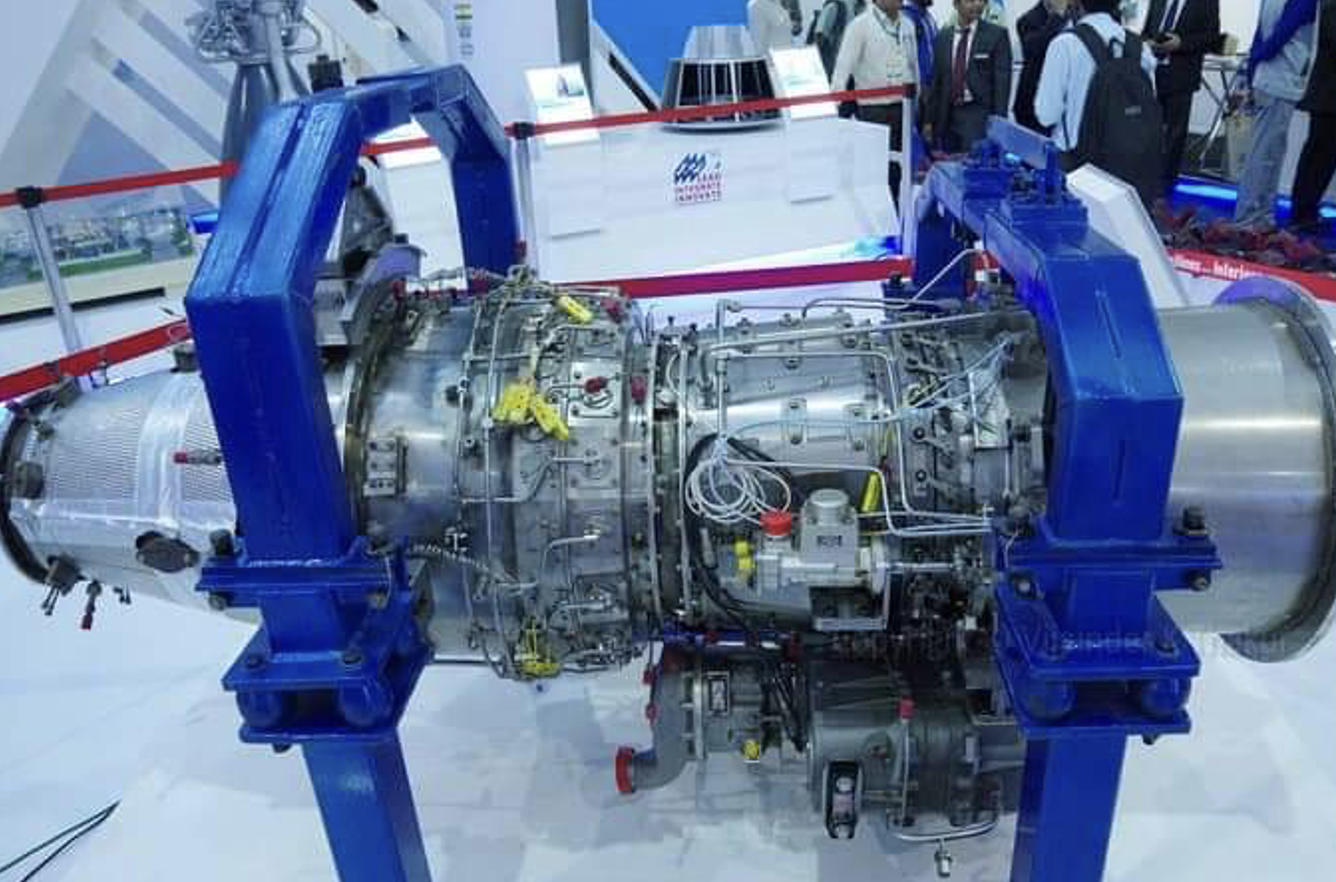
The Manik program also shows how long it can take to move from engine development to reliable operation as part of a complete weapon system. The engine was named Manik in late 2014 and was undergoing ground testing by 2015. Flight testing followed under the Indigenous Technology Cruise Missile (ITCM) program beginning in 2020.
Subsequent trials produced mixed results. The first ITCM flight in October 2020 deviated from its intended path and was terminated, while a June 2021 trial was successful. An August 2021 trial encountered a control-system problem, although the Manik engine reportedly performed as intended. Another test in October 2022 was cut short after an engine snag. A subsequent test in February 2023 successfully demonstrated the capabilities of the indigenous engine. By April 2024, DRDO said another successful ITCM flight had established the reliable performance of the indigenous propulsion system.
The earlier Nirbhay program relied on the Russian NPO Saturn 36MT while India developed and validated its own propulsion system. That history is a reminder that getting a small turbine to run is only one part of the challenge. Integrating it into a missile and demonstrating reliable performance in flight can take considerably longer.
The Ministry of Defence’s description of the new engine is also specific. It calls it India’s first indigenous expendable turbojet engine in the 350 kg thrust class. Manik is a turbofan, while the new engine is a turbojet. It therefore represents a different type of small gas-turbine propulsion suited to different expendable applications.
How “expendable” changed the math
There’s a common assumption that a small engine is an easy engine, or simply a scaled-down version of a larger one. It isn’t. Small gas turbines bring their own engineering challenges, and some become more difficult as the engine gets smaller.
The physics doesn’t scale cleanly. Smaller turbines have a higher surface-area-to-volume ratio, which can increase relative heat losses and reduce efficiency. Tip clearances also become a larger fraction of blade height, making leakage more significant. Small differences in manufacturing can therefore have a greater effect on performance. Bearings operate at high rotational speeds, while the combustor has to maintain stable combustion within a compact volume. None of this is trivial.
What makes an expendable engine a different problem is its service-life requirement. A reusable aircraft engine has to withstand repeated thermal and mechanical cycles over a long operating life. Those demands contribute to the need for advanced turbine materials, cooling systems, and thermal barrier coatings, particularly in the hottest sections of the engine. Modern turbine technology has evolved around managing high temperatures while maintaining component life and performance.
An expendable engine has a different set of priorities. It still has to operate reliably for its mission, but it doesn’t need to accumulate the repeated operating cycles expected from a reusable aircraft engine. That can reduce some of the durability requirements and allow designers to place greater emphasis on simplicity, cost, and manufacturability.
That distinction also helps put the reported 24-month timeline into context. Azad Engineering reportedly realized and delivered the engine in around two years, although the Ministry of Defence describes the milestone as the culmination of years of engineering. The team wasn’t solving the same service-life problem as a reusable fighter engine. It was solving a narrower propulsion problem with a different set of requirements.
Why turbojet
The choice of a turbojet rather than the turbofan architecture used by Manik isn’t a minor detail. It offers some clues about the types of applications the new engine could support, although GTRE hasn’t publicly identified a specific platform.
In a turbojet, the incoming air passes through the engine core. The compressor raises its pressure, fuel is burned in the compressed air, and the resulting hot gas expands through the turbine before exiting through the nozzle at high velocity. A turbofan adds a fan that creates a bypass stream around the core. Some air passes through the core, while the rest bypasses it and contributes additional thrust.
That bypass flow generally gives a turbofan better fuel efficiency at subsonic speeds. It’s one reason turbofans are well suited to subsonic cruise applications where range and fuel consumption matter. Manik, for example, was developed as a small turbofan for subsonic cruise missile and UAV applications and has been used in India’s indigenous cruise-missile program.
Turbojets offer a different trade-off. They generally provide higher specific thrust and can support a more compact engine installation, while consuming more fuel for a given level of thrust than a comparable turbofan in subsonic operation. Their simpler flow path can also reduce some of the mechanical complexity associated with a separate fan and bypass system.
That suggests the new engine may be intended for expendable platforms where compactness, speed, or cost matter more than maximum fuel economy. Missiles and other high-speed unmanned systems are plausible applications, but that remains an inference until GTRE provides more information about the engine’s intended platforms.
What’s new?
Since the official specifications are limited, the ideal approach is to separate what is known from what can reasonably be inferred and what remains unknown. What is known is that it’s an expendable turbojet in the 350 kgf thrust class. GTRE designed it, while Azad Engineering manufactured and assembled it. The engine was realized and delivered in roughly two years.
Related GTRE engine programs offer some clues about the technology that could be involved. The Manik engine, for example, uses a digital engine control and advanced fuel control system, mid-air starting with pyrotechnic devices, a mixed-flow compressor, a slinger combustor, and uncooled high-pressure turbine blades. A separate 2024 announcement from Azad Engineering for a GTRE-designed advanced gas-turbine engine described a single-spool turbojet with a four-stage axial-flow compressor, annular combustor, single-stage uncooled axial-flow turbine, and fixed-exit-area nozzle.
Those programs show the types of technologies GTRE has already developed for compact propulsion systems, but they don’t establish the architecture of the new 350 kgf engine. Its spool configuration, compressor and combustor design, control system, and turbine arrangement haven’t been publicly disclosed.
Other specifications also remain unknown, including its exact thrust-to-weight ratio, fuel type, endurance, dimensions, mass, and altitude envelope. It also hasn’t been publicly confirmed whether the engine has completed flight testing or has been assigned to a specific platform.
One of the more notable aspects of the program is the manufacturing model. GTRE designed the engine, while Azad Engineering manufactured and assembled it in Hyderabad. The company has previously worked with GTRE on the end-to-end manufacturing, assembly, and integration of gas-turbine engines, moving beyond individual precision components toward complete propulsion systems.
That capability matters beyond this engine. Gas turbines depend on tightly controlled manufacturing of components, such as blades, discs, and casings. Developing the industrial capacity to manufacture and assemble complete small turbine engines gives India a stronger domestic base for more demanding propulsion programs.
What it will power
Reporting has linked engines in this class with cruise missiles, loitering munitions, target drones, UAVs, and other expendable airborne platforms. The Ministry of Defence hasn’t identified a specific platform for the new engine, but those applications fit the role of a compact, single-use turbojet.
Cruise missiles need an engine that can run reliably for the duration of a strike. Jet-powered loitering munitions need compact propulsion that can support higher speed and range than many propeller-driven systems. Target drones and other expendable unmanned platforms can have similar requirements. Reporting has also identified possible applications including anti-ship missiles and other air-to-surface and air-to-air missile systems.
An indigenous engine in the 350 kgf class gives Indian designers another domestic propulsion option for these platforms. That reduces the need to import engines or design systems around foreign propulsion technology that may be affected by supply restrictions or geopolitical pressures.
Reducing dependence on imported propulsion is one of the program’s more important strategic implications. India has relied on foreign engines for some missile programs in the past, including the Russian NPO Saturn 36MT used during the development of Nirbhay. A domestic engine gives designers greater control over integration, production, and future development.
Having an engine and having a fielded weapon are still different things. Integration, flight testing, and qualification can take years, as the Nirbhay and Manik programs demonstrated. The new turbojet is an important enabler, but it isn’t a finished weapon capability on its own.
How it compares to Kaveri
Kaveri is the natural comparison because both are GTRE engines, but the two projects sit at different ends of the propulsion challenge. Comparing them helps explain why the new expendable engine could be realized and delivered on a much shorter timeline while Kaveri has been under development for more than three decades.
Kaveri began as India’s attempt to develop a fighter-class engine. Sanctioned in 1989 to power the Tejas Light Combat Aircraft, it’s a turbofan that produces roughly 49 to 51 kN of dry thrust in its current non-afterburning form. Its original fighter application also imposed demanding service-life requirements. A reusable engine has to withstand repeated thermal and mechanical cycles over thousands of operating hours, something the expendable turbojet doesn’t have to do to the same extent.
Kaveri’s history shows how difficult that challenge can be. The engine ran successfully, but it couldn’t meet the thrust and weight requirements needed for the Tejas. It was formally delinked from the aircraft program in 2008. The Tejas Mk1 and Mk1A instead use variants of the American General Electric F404.
Rather than abandon the technology, DRDO redirected part of the program. The dry Kaveri, also known as the Kaveri Derivative Engine, has been developed for unmanned applications including the Ghatak stealth unmanned combat aircraft. Without an afterburner, the engine produces less thrust but is better suited to an application that doesn’t require the same performance profile as a fighter.
The dry Kaveri has made considerable progress. High-altitude testing in Russia concluded in 2023, with the engine producing about 48.5 kN of thrust against a simulated target of 46 kN. It later received clearance for in-flight testing. By May 2025, further trials were underway in Russia, with defense officials reporting that around 25 hours of testing remained.
Work has also continued on an afterburning version. In February 2026, Defence Minister Rajnath Singh witnessed a full afterburner test at GTRE. More recent reporting indicates that GTRE is also pursuing a substantially redesigned Kaveri 2.0, targeting roughly 55 to 60 kN of dry thrust and 90 to 100 kN with afterburning. The proposed engine is aimed at bringing indigenous propulsion back into consideration for future fighter applications.
The new expendable turbojet benefits from the same institutional base built through decades of Kaveri development. GTRE has accumulated experience in engine testing, materials, control systems, manufacturing, and integration over that period. A small, single-use engine remains a significant engineering challenge, but it starts from a much stronger foundation than India’s early Kaveri work did.
The new turbojet therefore shouldn’t be read as evidence that India has solved the fighter-engine problem. It’s better understood as progress in a narrower class of propulsion while work on a reliable, high-thrust indigenous fighter engine continues.
Where it fits in India’s fighter engine story
If the question behind all of this is when India will have its own fighter engine, the expendable turbojet doesn’t answer it. India’s fighter-engine effort is moving along several tracks, each addressing a different part of the problem.
The first is Kaveri and the newer Kaveri 2.0 effort. Kaveri remains India’s homegrown aero-engine program, with the dry derivative aimed at unmanned aircraft. The revived Kaveri 2.0 is more ambitious and is intended to move the technology back toward fighter-class performance.
The second is the General Electric F414. This is the near-term path for aircraft that need more thrust than the F404 can provide while India’s domestic engine programs mature. The F414-INS6 produces around 98 kN and is planned for the Tejas Mk2 and the initial AMCA aircraft. HAL and GE Aerospace reached a technical agreement in 2026 covering local production with close to 80 percent technology transfer, although a final production contract had yet to be concluded.
That agreement has also faced commercial pressure. Reporting in 2026 indicated that GE’s proposed costs had risen substantially during negotiations. The dispute has added urgency to India’s effort to gain greater control over the engines that will power future combat aircraft.
The third track is a new high-thrust engine for later versions of the Advanced Medium Combat Aircraft. The initial AMCA will use the F414, while the more capable later version is expected to require an engine around the 120 kN class, with a potential growth path toward 140 kN. India wants the program to provide domestic design authority and intellectual property ownership rather than another conventional licensed-production arrangement.
Safran has emerged as a leading partner for that effort. The French company and GTRE have proposed jointly developing a new engine rather than adapting Safran’s existing M88. By early August 2026, the proposal had reached India’s Cabinet Committee on Security. Reports had suggested approval could come before August 15, but no approval had been publicly announced by August 20.
The competition also remains active. Rolls-Royce submitted a competing proposal offering full technology transfer and Indian ownership of intellectual property generated through the program. In August 2026, Rolls-Royce and Reliance Industries also announced plans to work together on an indigenous combat-engine proposal for AMCA.
The timelines remain long regardless of which path India chooses. Rolls-Royce has proposed testing an engine core around 2030, beginning flight testing in 2034, and entering production around 2036 if a contract is signed by the end of 2026. A Safran-led program would also require years of development, prototype testing, and certification.
India therefore doesn’t yet have an operational fighter-class engine that it owns and controls from design through production. The new expendable turbojet doesn’t change that. It sits in a different thrust class and serves a different mission, but it adds another piece to the domestic propulsion capability India is trying to build.
Conclusion
India’s first indigenous expendable turbojet engine is a meaningful achievement in a category the country has been developing for years. The reported 24-month manufacturing and delivery timeline reflects the narrower service-life requirements of an expendable engine, not a sudden solution to the much harder challenge of fighter-class propulsion.
One of the more significant outcomes may be the manufacturing capability behind the program. Azad Engineering has demonstrated that a private Indian company can manufacture and assemble a complete small turbine engine, building experience that could support more demanding propulsion programs in the future.
The engine also gives India another domestic option for missiles, loitering munitions, and other unmanned systems. Its strategic value lies in reducing dependence on imported propulsion and giving Indian designers greater control over future platforms. A working engine is still only one part of that process, though. Integration, flight testing, and qualification will determine when it becomes part of an operational system.
References
- https://www.airforce-technology.com/news/drdo-india-expendable-turbo-jet-engine
- https://organiser.org/2026/07/24/371428/bharat/drdo-develops-indias-first-indigenous-350-kg-thrust-class-expendable-turbojet-engine
- https://thenewsmill.com/2026/07/drdo-develops-indias-first-indigenous-350-kg-thrust-expendable-turbojet-engine
- https://www.eletimes.ai/india-develops-indigenous-expendable-turbojet-engine-for-future-missile-system
- https://www.deccanherald.com/national/drdo-successfully-tests-nirbhay-missile-engine-designed-by-labs-in-bengaluru-1018720.html
- https://www.livefistdefence.com/exclusive-crucial-engine-for-indias-cruise-missiles-revs-up
- https://frontierindia.com/indian-tests-nirbhay-missiles-manik-turbofan-engine-for-short-range-indigenous-technology-cruise-missile
- https://saenitk.wordpress.com/2022/07/24/kaveri-engine
- https://idrw.org/kaveri-derivative-engine-kde-for-ghatak-to-have-75-commonality-with-kaveri-afterburner-engine
- https://idrw.org/gtre-secures-approval-for-dry-kaveri-engine-integration-with-new-afterburner-for-lca-tejas-testing
- https://meta-defense.fr/en/2026/08/05/safran-gtre-amca-mk2-engine-project-india
- https://quwa.org/india-defence-news/safran-gtre-fighter-engine-joint-venture-reaches-indias-ccs
- https://theprint.in/defence/engine-core-by-2030-test-flight-by-2034-production-by-2036-rolls-royce-makes-final-pitch-to-power-amca/2967532
- https://www.opindia.com/2026/06/amca-project-faces-a-massive-engine-dilemma-rolls-royce-and-safran-bids-become-stronger-after-ge-raised-cost
- https://www.eurasiantimes.com/better-than-rafale-super-hornet-meet-indias-indigenous-tedbf-fighters
You may also like:




Filed Under: Tech Articles
Log in to leave a comment:
Lost your password?
Don't have an account? Register here